October 10, 2025 3 min read

Links: Week of 11 Oct 2025

  1. JS
    Justin Skycak@justinskycak · Oct 4

    Last year I had a conversation with someone who majored in physics at UChicago. He initially started in math & thought he was prepared having taken AP Calculus BC, but he got smacked in the face by the level of abstraction and proof-writing ability that was assumed.

    He couldn't keep up with his classmates who had already done proofs while taking even MORE advanced courses in high school. So he switched to physics where proofs were less frequent & the playing field felt more level in terms of prior knowledge that classmates had coming in.

    He would have liked to study math if he had more time to catch up, or if he knew earlier how far behind he was – but he did great in his high school math classes & was recognized as one of the "smart kids," so he never suspected he was actually behind the curve.

    Zooming out, this case study is representative of a general phenomenon that can sneak up on you when you’re at, say, the 99th percentile of a skill.

    At first, you’re exceptional enough that you receive praise from virtually everyone, and you may never go head-to-head with someone who can beat you.

    That is, until you join some specialized program where everyone is at the 99.9th percentile – where, suddenly, you’re the worst one there.

    And here’s the real kicker: if it’s a time-sensitive program, you may be so far behind that it’s infeasible to catch up.

    If you knew the caliber of these people earlier, you could have spent time working harder to join their ranks in the 99.9th percentile…

    but that moment has passed, and now the door is closed on this opportunity.

  2. I think people who are facing a sudden reversal can learn from my experience. You can get through it. You have family, you have friends, you have resources that you don’t even know that you have.

  3. NS
    Noah Smith 🐇🇺🇸🇺🇦🇹🇼@Noahpinion · Oct 9

    Is 5'11" (180.3 cm) tall, average, or short?

October 3, 2025 4 min read

Links: Week of 04 Oct 2025

  1. One day as I was being lectured by a female HR representative for leaving my (cloth, non-medical) mask off for too long during lunch, I could barely hear what she was saying. All I could think of were the uncounted men across untold generations who had lived and died as warriors, with all the honor and pain that entailed. I thought of how men in Ukraine right now lived a modern version of that, while I allowed myself to be subject to the feminized safteyist ideology of everyday civilization.

    The spiritual offensiveness of this contrast hit me like a ton of bricks, more vividly than ever. At that moment I silently made my final decision. I wasn’t going to wait around to hear back from the Ukrainian Government. It was time, in the immortal words of an ISIS recruiter on Twitter to “put down the chicken wings n come to jihad, bro”.

    The entire non-book review contest at Astral Codex Ten has been fantastic.

  2. Like most people, I’ve noticed that time seems to speed up as one gets older. I moved to California in 2017, and the past 8 years seemed to pass by very quickly. I feel like time is moving twice as fast as when I was 35. Even as a 16-year old high school student I had already noticed that those “long summer vacations” seemed to pass by at twice the speed as when I was only 8 years old.

    In mathematical terms, subjective time seems roughly proportional to the inverse of one’s age. (At least since age 3 or 4, before that I recall nothing.) At age N, each lived year represents 1/nth of our life. If this is true, then this has some fairly startling implications.

  3. LN
    Leading Nowhere@leading_nowhere · Oct 2

    A life well lived, can anyone ask for more.

  4. NS
    Noah Smith 🐇🇺🇸🇺🇦🇹🇼@Noahpinion · Apr 22

    What's also kind of nuts about this is how spiky China's pyramid is, compared to how smooth India's is.

    Those spikes are the legacy of the Great Leap Forward famine and the One-Child Policy.

  5. Let me repeat that: Parties are a public service, you’re doing people a favor by throwing them. Someone might meet their new best friend or future lover at your gathering. In the short term, lovely people may feel less lonely, and that's thanks to you. In the long term, whole new children may ultimately exist in the world because you bothered to throw a party. Throwing parties is stressful for most people, but a great kindness to the community, so genuinely pat yourself on the back for doing this.

    Not so much facts, as very good opinions, but still.

  6. It has gone largely unnoticed that time spent on social media peaked in 2022 and has since gone into steady decline, according to an analysis of the online habits of 250,000 adults in more than 50 countries carried out for the FT by the digital audience insights company GWI. And this is not just the unwinding of a bump in screen time during pandemic lockdowns — usage has traced a smooth curve up and down over the past decade-plus.

    Societies, generations tend to develop immunity from toxic trends over time.

  7. It has gone largely unnoticed that time spent on social media peaked in 2022 and has since gone into steady decline, according to an analysis of the online habits of 250,000 adults in more than 50 countries carried out for the FT by the digital audience insights company GWI. And this is not just the unwinding of a bump in screen time during pandemic lockdowns — usage has traced a smooth curve up and down over the past decade-plus.

    Is it surprising that a system trained on human output is tribal, favoring in-group over out-group?

  8. Please expect a very high rate of change from us; it reminds me of the early days of ChatGPT. We will make some good decisions and some missteps, but we will take feedback and try to fix the missteps very quickly. We plan to do our iteration on different approaches in Sora, but then apply it consistently across our products.

September 26, 2025 4 min read

Links: Week of 27 Sep 2025

  1. SA
    Sam Altman@sama · Sep 25

    Today we are launching my favorite feature of ChatGPT so far, called Pulse. It is initially available to Pro subscribers.

    Pulse works for you overnight, and keeps thinking about your interests, your connected data, your recent chats, and more. Every morning, you get a custom-generated set of stuff you might be interested in.

    It performs super well if you tell ChatGPT more about what's important to you. In regular chat, you could mention “I’d like to go visit Bora Bora someday” or “My kid is 6 months old and I’m interested in developmental milestones” and in the future you might get useful updates.

    Think of treating ChatGPT like a super-competent personal assistant: sometimes you ask for things you need in the moment, but if you share general preferences, it will do a good job for you proactively.

    This also points to what I believe is the future of ChatGPT: a shift from being all reactive to being significantly proactive, and extremely personalized.

    This is an early look, and right now only available to Pro subscribers. We will work hard to improve the quality over time and to find a way to bring it to Plus subscribers too.

    Huge congrats to @ChristinaHartW, @_samirism, and the team for building this.

  2. Right now, however, Beast Industries is hemorrhaging money. It’s had three years of losses, including more than $110 million in 2024. The viral videos account for all of it, overwhelming the profits from Feastables. Donaldson has been spending between $3 million and $4 million on every video he produces for the main YouTube channel, most of which lose money. In 2023, Beast spent $10 million to $15 million shooting videos it never released to the public because they weren’t up to its standards. He also lost tens of millions of dollars producing Beast Games, a popular show for Amazon Prime Video in which 1,000 people competed for $10 million by, among other things, moving a 10,000-pound boulder.

  3. AP
    Alex Prompter@alex_prompter · Sep 22

    This is going to revolutionize education 📚

    Google just launched "Learn Your Way" that basically takes whatever boring chapter you're supposed to read and rebuilds it around stuff you actually give a damn about.

    Like if you're into basketball and have to learn Newton's laws, suddenly all the examples are about dribbling and shooting. Art kid studying economics? Now it's all gallery auctions and art markets.

    Here's what got me though. They didn't just find-and-replace examples like most "personalized" learning crap does. The AI actually generates different ways to consume the same information:

    - Mind maps if you think visually
    - Audio lessons with these weird simulated teacher conversations
    - Timelines you can click around
    - Quizzes that change based on what you're screwing up

    They tested this on 60 high schoolers. Random assignment, proper study design. Kids using their system absolutely destroyed the regular textbook group on both immediate testing and when they came back three days later.

    Every single one said it made them more confident.

    The part that surprised me? They actually solved the accuracy problem. Most ed-tech either dumbs everything down to nothing or gets basic facts wrong.

    These guys had real pedagogical experts evaluate every piece on like eight different measures.

    Look, textbooks have sucked for centuries not because publishers are idiots, but because making personalized versions was basically impossible at scale. That just changed.

    This isn't some K-12 thing either. Corporate training could work this way. Technical documentation. Professional development.

    Imagine if every boring compliance course used examples from your actual job instead of generic office scenarios.

    We might have just watched the industrial education model crack for the first time. About damn time.

Ignoring the hype up top, Google does seem to be creating some practical tools with LLMs. With base LLMs getting quite good now, I wonder if the next unlock is in creating tools with customized workflows for specific tasks. Wrappers.

  1. Periodic Videos
September 20, 2025 6 min read

Links: Week of 20 Sep 2025

  1. If you’ve got a compliment, just let it out.

    JP
    jay plemons@jayplemons · Sep 7

    The Power of a Compliment

    Scott Adams tells the story of a woman in a public speaking class who transforms from terrified to confident through encouraging words from her peers

    @ScottAdamsSays “If you withhold a compliment that you’re thinking, it’s almost immoral.

    If you’ve got a compliment, just let it out.”

  2. And the amazing thing is that the opposite works too!

    I think I mentioned this before but I was a national speech and debate octafinalist in high school and I was able to parlay that into a job running a debate program at an ambitious charter middle school in college.

    My approach was the exact opposite of this. Like half the kids were TERRIFIED of public speaking and were only doing it because their tiger moms insisted they had to (and the other half LOVED the attention).

    I had a lot of trouble getting the scared kids to open up and one day I asked one of the youngest ones what made her so afraid of speaking in front of the class, especially since they were all her friends.

    And she told me she was afraid she’d say something dumb or make a mistake and everyone would make fun of her. And that they’d laugh and laugh at her if she froze up.

    The next day I asked the class if anyone was scared of being made fun of and all the shy kids raised their hands.

    Now I don’t actually know if this is the same pathology in adults with fear of public speaking but I suspect it’s similar, and now I’ll get to how I addressed it which worked fabulously.

    First I told them that this was a ridiculous fear and that no one would make fun of them. But of course that doesn’t do anything lol. But then I told everyone to rip out 10 pieces of paper from their notebooks and crumple them up.

    And I told them I was going to give a speech. I told them if I said “uhh” or “um” or used any filler words they were to throw a paper ball at me and shout “shame!” 3 times pointing at me.

    And I gave a terrible speech. And they loved it! It was so much fun for them.

    But then! I had the students give speeches with the same rules, starting with the confident ones.

    After the third student the shy ones were volunteering.

    After the lesson I explained to them that we had accomplished 2 things:

    1. We had demonstrated how absurd such a reaction really is, because none of them would have ever reacted in that way if they weren’t specifically asked to, and none of them had any actual malice even when they did shout “shame” at their classmates

    2. Everyone had experienced the comically worst case scenario imaginable of public speaking and survived!

    So they became the rule during EVERY class and I was told by the other teachers that my shy students had started leading presentations and speaking up in class and some of them asked me how I worked with them.

    They were HORRIFIED when I told them lol.

    But it worked!

    This reminds me of Boggarts in the Harry Potter books.

  3. This guy is founding an evangelical church, and I find his ecosystem fascinating. First for its stunning similarities to venture-capital-funded tech start-ups, and then for its simplicity and open-heartedness. None of the dynamics in church planting are unique or even particularly rare, but they are unobfuscated, and that makes church planting the equivalent of a large print book for the social dynamics that favor charismatic narcissists.

  4. Finnish tech firm Bluefors, a maker of ultracold refrigerator systems critical for quantum computing, has purchased tens of thousands of liters of Helium-3 from the moon — spending “above $300 million” — through a commercial space company called Interlune. The agreement, which has not been previously reported, marks the largest purchase of a natural resource from space.

  5. CS
    Chris Said@Chris_Said · Sep 17

    Teen depression has *declined* for the past 4 years, after peaking in 2021.

    People should update on this.

    The most parsimonious explanation is @glukianoff's theory that wokeness encouraged catastrophic thinking, acting as a sort of “reverse CBT”.

  6. We received the problems in the exact same PDF form, and the reasoning system selected which answers to submit with no bespoke test-time harness whatsoever. For 11 of the 12 problems, the system’s first answer was correct. For the hardest problem, it succeeded on the 9th submission. Notably, the best human team achieved 11/12.

    We competed with an ensemble of general-purpose reasoning models; we did not train any model specifically for the ICPC. We had both GPT-5 and an experimental reasoning model generating solutions, and the experimental reasoning model selecting which solutions to submit. GPT-5 answered 11 correctly, and the last (and most difficult problem) was solved by the experimental reasoning model.

    and

    An advanced version of Gemini 2.5 Deep Think competed live in a remote online environment following ICPC rules, under the guidance of the competition organizers. It started 10 minutes after the human contestants and correctly solved 10 out of 12 problems, achieving gold-medal level performance under the same five-hour time constraint. See our solutions here.

September 13, 2025 8 min read

Links: Week of 6 & 14 Sep 2025

  1. The journeyman played for eight N.B.A. teams and won one championship. But he is best known for a brief stretch on the Knicks where he electrified fans and the nation.

    How to feel old #3892: Linsanity for 13 years ago and I remember it like it was yesterday!

  2. The amount of planning and thought that needs to go into the enterprise is surprisingly minimal. Count how many days you’re going for, then bring the same number of shirts as the number of days minus one (unless you have access to laundry, then probably less), 2-4 pairs of pants, a couple nicer dresses if that’s your thing and a change of shoes. Something to sleep in at night and a bathing suit if you’re headed somewhere warm. I always bring an extra pair of underwear and socks because sometimes I like to change throughout the day. Then experiment by trying on a bunch items to ensure everything goes together. Frankly, it’s not that different than figuring out what you’re going to wear on a day-to-day basis, which I trust you do all the time.

    Some thinking about packing, maybe some tools (I like using packing cubes and a travel scale is a must when flying budget) are surprisingly useful but yes, the curve drops sharply.

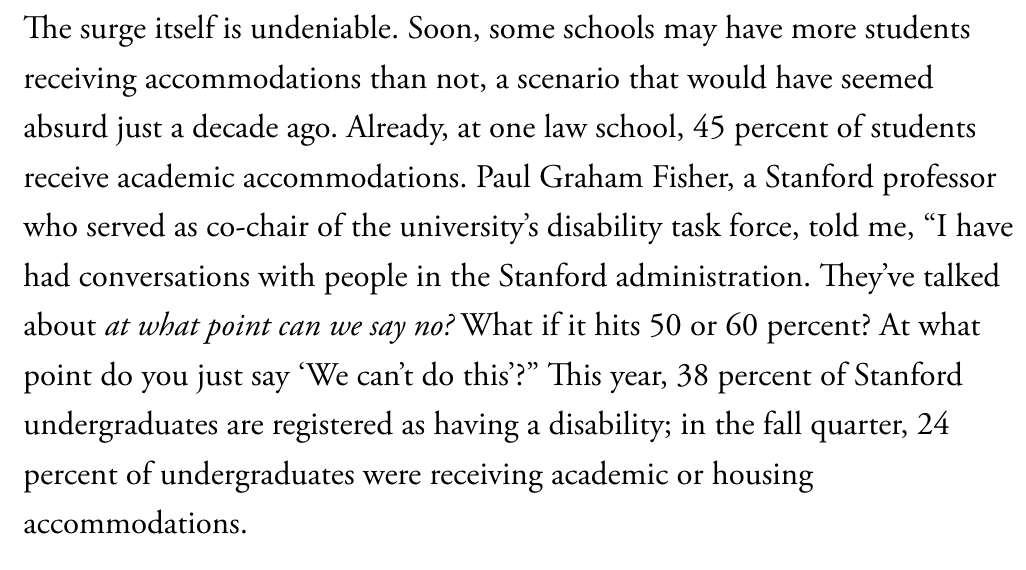
  3. At 22, I thought ADHD was fake. An excuse for underachieving kids to get “accommodations” for procrastinating on their homework. From what vague knowledge I had of stimulants like Adderall, I regarded them with the same scorn as the accommodations.

    Seventeen years later, I credit Adderall with enabling me to build a 10x happier, healthier, more virtuous version of myself (to the chagrin of the countless Twitter trolls decrying my “meth addiction” in reply to this recent viral post). Here is my story.

  4. All this effort — fifty years of non-stop toil — turning a fallow wasteland into fertile earth, and where are all the crops we have to show for it? Where are all the local companies that we can point to and be proud of? Where are our Ericssons and Nokias?

  5. Rob was fantastic but it’s not as though I can just do a TrackMan excursion all the time. Yet I remained curious about why my swing was what it was. I had decent power, but lacked the ability to square the ball up with anything approaching consistency. Was I destined to always have this problem?

    And so I turned to LLMs, feeding the TrackMan stats into GPT. Based on 12 numbers, from one swing, GPT had me clocked. It knew my strengths and weaknesses. It fully understood the specifics of my poor technique. I’m sure Rob could have walked me through as much, but his time is limited. The machine had all the bandwidth in the world to deal with my “over the top” swing, how to fix it, and any other questions I might nag it with.

    A day later, my swing was different and self recorded video sent to Google’s Gemini confirmed the change. Swing errors that were decades in the making were corrected in the span of minutes. I’m not saying that I’ve suddenly made a leap from “Struggles to break 100” to “scratch golfer.” I’m just saying that a process that could have been expensive and arduous was instead efficient and relatively cheap. I apply the LLM’s fix, and it tells me whether I’ve actually applied it. The feedback is instant and objective.

    LLMs will be like Ozempic for a lot more than golf. Ability to ask unlimited questions without feeling embarrased or paying by the hour is a big deal. Imagination is the only thing limiting us.

  6. It’s hard to say exactly why, even with all this progress, current AI models are still so hopeless at dealing with open-ended real-world situations. GPT-5’s inability to recognize that it was incapable of playing Minesweeper may indicate that its reasoning abilities do not generalize well. Its decision to spend 5 solid hours beating its head against the unimportant side goal of sharing a spreadsheet suggests a lack of training on the importance of setting priorities. The repeated factual errors in Gemini 2.5 Pro’s writeup of its merch store experience (click the link and look for “Editor’s Notes”) suggest an inability to keep track of key information over an extended project. Claude losing track of the fact that it is not a person is a reminder that in some ways these models really are just shallow imitations of human behavior (even as they demonstrate deep capability in other areas).

    So many benefits and so many limitations.

  7. Reading a non-fiction book from cover-to-cover is not efficient. I used to say that I read books “from the outside in.” I look at the book flap to find out about the author, who wrote the blurbs, and the subject matter of the book. Then I read the introduction and conclusion in order to get the main ideas. If I have read something by a different author that seems relevant, I look for that author in the index, and I head to those pages.

    and

    Once again, I believe in “Stop, Look, and Listen.” I start by asking the AI to summarize the key themes of the book. For each theme that the AI lists, I stop and try to put it into my own words. I test my understanding by feeding my words into the AI, in order get confirmation that my interpretation is correct. Another way that I ensure understanding is to suggest possible examples or ask the AI to provide examples.

  8. The Zvi has a good survey post on what is going on with the actual evidence. I have a more general point to make, which I am drawing from my background in Austrian capital theory.

    There are easy projects, and there are hard projects. You might also say short-term vs. long-term investments.

    The easier, shorter-term projects get done first. For instance, the best LLMs now have near-perfect answers for a wide range of queries. Those answers will not be getting much better, though they may be integrated into different services in higher productivity ways.

    Those improvements will yield an ongoing stream of benefits, but you will not see much incremental progress in the underlying models themselves. Ten years from now, the word “strawberry” still will have three r’s, and the LLMs still will tell us that. There are other questions, such as “what is the meaning of life?” where the AI answers also will not get much better. I do not mean that statement as AI pessimism, rather the answers can only get so good because the question is not ideally specified in the first place.

    Then there are the very difficult concrete problems, such as in the biosciences or with math olympiad problems, and so on. Progress in these areas seems quite steady and I would call it impressive. But it will take quite a few years before that progress is turned into improvements in daily life. Again, that does not have to be AI pessimism. Just look at how we run our clinical trials, or how long the FDA approval process takes for new drugs, or how many people are reluctant to accept beneficial vaccines. I predict that AI will not speed up those processes nearly as much as it ideally might.

    So the AI world before us is rather rapidly being bifurcated into two sectors:

    a) progress already is extreme, and is hard to improve upon, and

    b) progress is ongoing, but will take a long time to be visible to actual users and consumers

    And so people will complain that AI progress is failing us, but mostly they will be wrong. They will be the victim of cognitive error and biases. The reality is that progress is continuing apace, but it swallows up and renders ordinary some of its more visible successes. What is left behind for future progress can be pretty slow.

    Yet another periodic reminder that MR and The Zvi are both must-read for everyone.

August 29, 2025 2 min read

Links: Week of 30 Aug 2025

  1. Exploring the India that often escapes headlines through the lived experiences of an ABCG: American Born Confused Gora. It’s a look beyond polished narratives and the obvious into the beautiful contradictions that actually power the country.

  2. SD
    Sam D'Amico@sdamico · Aug 24

    A giant disconnect I see in society right now is the fact that self driving will absolutely take over, AI will absolutely enable 1:1 tutoring for every child, and the past benefits of “good school districts” and housing built around driving personal vehicles will make less sense.

  3. while it's true each generation of frontier model didn't get more expensive per token, something else happened. something worse. the number of tokens they consumed went absolutely nuclear.

  4. Patrick OShaughnessy podcast with Joe Liemandt, Principal @ Alpha School

  5. Failure of imagination is the only thing holding us back!

    “paula”@paularambles · Aug 27

    my mom just found a new use case for chatgpt

August 22, 2025 6 min read

Links: Week of 23 Aug 2025

  1. On the porch of the Chilmark General Store and at sunset-watching parties on Menemsha Beach, conversations circle ineluctably to the lone star tick, which after a single bite can leave people with a life-threatening allergy to most meat and dairy.

    Known as alpha-gal syndrome, the condition is changing the way many people shop, cook and eat in a place long known as a food-lover’s retreat for its thriving independent farms and restaurants. These new habits may prove to be lasting, as some islanders who initially avoided beef and cheese temporarily, out of necessity, later give them up for good out of preference.

    “It’s sort of supersized vegetarianism,” said Rebecca Miller, a farm owner who has the syndrome herself.

  2. So, when a recent government advisory put samosas — along with other deep-fried Indian snacks and Western foods such as burgers and French fries — on a list of things that should be eaten in moderation because of their high oil and sugar content, there was an unsurprising outcry. Social media erupted with memes, and Indian media chimed in to say the country’s most iconic bites were under attack.

  3. That animals seemingly anticipate events should humble us more. Changes in groundwater chemistry, electromagnetic fields and sound waves make animals restless, distressed and even relocate

    In the West it is seen as ‘woo’ to contemplate that energy/weather humans don’t consciously experience can affect our psychology, and yet we forget that we are animals too.

    Even outside extreme weather events, the lunar cycle moves oceans, huge bodies of water. We are, like all animals, primarily made of water. The word ‘lunacy’ comes from the ancient understanding that our minds can be affected by it

    An interesting experiment is to log your daily mood for a few months- ups and downs, anxiety / joy levels, big arguments with loved ones etc. Then afterwards, retroactively chart it against lunar cycles and NASA space weather data that tracks geomagnetic storms, solar flares etc.

    Be open- minded and try it. I, too, used to think this stuff was BS

    Now I think much of modern psychiatry is giving people drugs to tune down people’s individual responses to these external inputs, eg ‘bipolar’ might just indicate high sensitivity

    How many important scientific breakthroughs lie on the other side of our collective dismissal of ‘woo’?

    cows
  4. First, I’m now convinced that ChatGPT understands what it reads. Second, reasoning models persuade me that ChatGPT is creative. Third, ChatGPT summarizes texts extremely well, which I believe to be a robust measure of intelligence.

  5. "The better news is that this is happening at a time when exercise seems to be increasing for many groups, especially the young and old. The bad news is ... deep Medicaid cuts and declines in childhood vaccine uptake are not exactly optimistic predictors of American health."

  6. “Anyone that has worked at camp or grown up in the camp world understands there is a powerful people connection that forms at camp,” said Liam Macleod, a longtime camp professional and marketing director at Camp No Counselors. “It’s camp magic and it’s hard to replicate in the regular world.”

  7. It took months of effort to understand what the AI was doing. It turned out that the machine had used a counterintuitive trick to achieve its goals. It added an additional three-kilometer-long ring between the main interferometer and the detector to circulate the light before it exited the interferometer’s arms. Adhikari’s team realized that the AI was probably using some esoteric theoretical principles that Russian physicists had identified decades ago to reduce quantum mechanical noise. No one had ever pursued those ideas experimentally. “It takes a lot to think this far outside of the accepted solution,” Adhikari said. “We really needed the AI.”

  8. GPT-5, our newest flagship model, represents a substantial leap forward in agentic task performance, coding, raw intelligence, and steerability.

    While we trust it will perform excellently “out of the box” across a wide range of domains, in this guide we’ll cover prompting tips to maximize the quality of model outputs, derived from our experience training and applying the model to real-world tasks. We discuss concepts like improving agentic task performance, ensuring instruction adherence, making use of newly API features, and optimizing coding for frontend and software engineering tasks - with key insights into AI code editor Cursor’s prompt tuning work with GPT-5.

    We’ve seen significant gains from applying these best practices and adopting our canonical tools whenever possible, and we hope that this guide, along with the prompt optimizer tool we’ve built, will serve as a launchpad for your use of GPT-5. But, as always, remember that prompting is not a one-size-fits-all exercise - we encourage you to run experiments and iterate on the foundation offered here to find the best solution for your problem.

    And a tutorial by Anthropic.

August 15, 2025 5 min read

Links: Week of 16 Aug 2025

  1. I meet a lot of people who don’t like their jobs, and when I ask them what they’d rather do instead, about 75% say something like, “Oh, I dunno, I’d really love to run a little coffee shop.” If I’m feeling mischievous that day, I ask them one question: “Where would you get the coffee beans?”

    If that’s a stumper, here are some followups: Which kind of coffee mug is best? How much does a La Marzocco espresso machine cost? Would you bake your blueberry muffins in-house or would you buy them from a third party?

    The point of the Coffee Beans Procedure is this: if you can’t answer those questions, if you don’t even find them interesting, then you should not open a coffee shop, because this is how you will spend your days as a cafe owner. You will not be sitting droopy-lidded in an easy chair, sipping a latte and greeting your regulars as you page through Anna Karenina. You will be running a small business that sells hot bean water.

    1. It’s almost impossible to have an easy life and be interesting. Suffering is what gives people texture.

    and

    1. Heaven is a set of gradually increasing but attainable challenges.

    Listicle has become a bad word but there is a reason they are popular. A well done one is *chef's kiss *.

    1. The physicist Michael Nielsen tells us that the Polish-American mathematician Stanislaw Ulam perceived his life as sharply divided into two halves: “In the first half, he was always the youngest person in the group. In the second half, he was always the oldest. There was no transitional period.” There was no transitional period.

    and

    1. ... The human condition is that we want it all, and we’re not willing to make trades… ‘deathbed regrets’ typically have the bias of wanting the other path—the path they could have taken—without considering the cost of that path. So they say, “Hey I was really successful and I did all these things, but you know, I would give it all up today to have my family.” It’s like, well yeah, but you didn’t, because you actually chose the path that you’re on, and you weren’t willing to do that. What you are saying right now is that you want it all. Sure. So does everyone.
  2. Mad respect for whoever decided that there was a business opportunity here and then made it happen.

    JB
    JUNK BOND ANALYST@junkbondanalyst · Aug 10

    First time hearing about this for me. There’s platforms for buying someone else’s non-refundable vacations at a discount.

    There’s always a trade to do.

  3. “I suspect that he heard three simultaneous things,” Mr. Harris said of the person whose home was hit. “One was the collision with his roof, one was a tiny cone of a sonic boom, and a third was it impacting the floor all in the same moment.”

    Looking at the photos, I think he would have died if it had struck him. Here's another amazing ancient rock story from the NYT.

  4. The ratio of members!

    RL
    Reddit Lies@reddit_lies · Aug 11

    Dating AI is an almost exclusively a female trait fyi.

    The movie "Her" should have been about a woman.

  5. Great thread from a master. Love how he says so much without saying anything. See the photos in the third tweet for a masterpiece (as he puts it, the 3rd and the 4th slide.).

    DG
    derek guy@dieworkwear · Aug 13

    Have you ever noticed that people dressed better in the past? Even in the summer, when it was scorching hot?

    Why is this? 🧵

    DG
    derek guy@dieworkwear · Aug 13

    Even the details had shape: a camp collar, boat neck, or button-down.

    Over the years, these details have shrank, if not disappeared altogether. Compare the 3rd and 4th slides. One button-down collar has a full roll; the other looks like its apologizing for its own existence.

  6. Solutions from experts follow a familiar pattern, claiming that the only way to avert a crisis is to adopt radical social and behavioral changes, driven by moral proselytizing, government intervention, or both, to save the water supply. Environmentalists urge people to replace old toilets with low-flow models, avoid running faucets while brushing their teeth or washing dishes, and switch to eating less water-intensive foods. Meanwhile, activists pressure elected officials to impose usage restrictions, ban certain crops in arid regions, and regulate everything from swimming pools to car washes.

    Fortunately the economics of water innovation reveals why the apparent scarcity tends to be self-correcting, without requiring us to adopt ascetic lifestyles or perform symbolic actions like picking up dropped ice cubes to water house plants or writing letters to elected officials. Rising prices, not moralizing pleas, lead people to conserve, look for substitutes, recycle resources, and innovate helping to meet demand through alternative means or improved efficiency.

    The same principles apply to many other things too.

  7. RP
    Ross Pomerantz@TheRealCorpBro · Aug 7

    Product review of my 4 month old son

August 8, 2025 4 min read

Links: Week of 09 Aug 2025

  1. The right way to begin is with one-card poker. Everyone antes one chip and gets one card, face down. You look at your card. There’s a single round of betting, which proceeds around the table: If no one else has bet, you can bet or check (do nothing); if anyone in front of you has bet, you can call (or match the bet), raise or fold. When everyone has called the last bet or folded, those who are left in the hand show their card. The highest card wins: Ace is highest, then king, so on down to two.

    That’s it. No pairs, no flushes, no full houses, no complicated order of hands to remember, though you do have to remember that a queen beats a jack. But you learn a lot of poker. You will always win with an ace, but you have to learn to maximize the value of your ace, to induce other people to bet into you and call your raises. One of my proudest moments as a parent was when my daughter first check-raised me with an ace.

    You’ll probably win with a king, but if someone raises you, does that mean that they have an ace (and have you beat), or a queen (and are overconfident), or a six (and are bluffing)? There are 52 cards, so you can estimate the probabilities if you are mathematically inclined, though if you are four you probably won’t.

    You probably won’t win with a six, but if you bet it confidently you might bluff everyone else out. If everyone else checks, and you’re the last person to bet, you might as well bet: You have “position,” everyone else has a weak hand, and you might be able to steal a pot. The essentials are there.

    Once the kids have mastered this, you can introduce the order of hands gently with two-card poker. (Any pair beats a high card, highest pair wins.) Then teach the rest with five-card straight poker. This isn’t a great game, but it’s a brief stopover on the way to five-card draw, which is a perfectly respectable poker game. Texas hold’em is not far behind.

  2. The chuño-chomping Incans were not the last military to rely on dehydrated potatoes for sustenance. In World War II, the US Army experimented with various forms of potato dehydration to help stretch supply lines. The easiest way to get a uniform potato commodity into the hands of G.I.s was to pulverize the potatoes into granules, dehydrate them, and then plan on bringing them back to life with boiling water in an imitation of “mashed potatoes”.

    Deeper than I would have imagined from the title.

  3. A lot more than you wanted to read on College and College Admissions. Depressing.

  4. A few weeks ago, I started receiving a stream of message about an Instagram post that I was allegedly starring in, where after offering my views on Palantir's valuation, I was soliciting investors to invest with me (or with an investment entity that had ties to me). I was not surprised, since I have lived with imitations for years, but I was bemused, since I don't have an Instagram account and have not posted on Facebook more than once or twice in a decade. In the last few days, those warnings have been joined by others, who have noted that there is now a video that looks and sounds like me, adding to the sales pitch with promises of super-normal returns if they reach out, and presumably send their money in. (Please don't go looking for these scams online, since the very act of clicking on them can expose you to their reach.)

    It was a matter of time.

  5. GPT-5 just does stuff, often extraordinary stuff, sometimes weird stuff, sometimes very AI stuff, on its own. And that is what makes it so interesting.

    To be clear this wasn't my experience. I gave it a PDF and asked it to estimate something based on the data in the file. It made up all the numbers and suggested they were in tables and pages that didn't exist in the PDF. I was not able to get it focused on the actual information in the PDF despite multiple reminders and other attempts. Apparently though, there was a bug in their system yesterday that made it appear dumber. I will try again.

August 1, 2025 6 min read

Links: Week of 02 Aug 2025

  1. These aren't generic "tech books." They're works that can shape how serious builders think about what they're creating and why.

    And the original essay.

  2. The tool, called the “DOGE AI Deregulation Decision Tool,” is supposed to analyze roughly 200,000 federal regulations to determine which can be eliminated because they are no longer required by law, according to a PowerPoint presentation obtained by The Post that is dated July 1 and outlines DOGE’s plans. Roughly 100,000 of those rules would be deemed worthy of trimming, the PowerPoint estimates — mostly through the automated tool with some staff feedback. The PowerPoint also suggests the AI tool will save the United States trillions of dollars by reducing compliance requirements, slashing the federal budget and unlocking unspecified “external investment.”

    A worthy goal for DOGE and possibly the right use of AI. If done well.

  3. Otherwise, while this is far from a perfect plan or the plan I would choose, on the substance it is a good plan, a positive plan, with many unexpectedly good plans within it. There is a lot of attention to detail in ways those I’ve asked say reflect people who actually know what they are doing, which was by no means something to be taken for granted. It is hard to imagine that a much better plan could have been approved given who was doing the approving.

  4. JF
    Jim Fan@DrJimFan · Jul 25

    I'm observing a mini Moravec's paradox within robotics: gymnastics that are difficult for humans are much easier for robots than "unsexy" tasks like cooking, cleaning, and assembling. It leads to a cognitive dissonance for people outside the field, "so, robots can parkour & breakdance, but why can't they take care of my dog?" Trust me, I got asked by my parents about this more than you think ...

    The "Robot Moravec's paradox" also creates the illusion that physical AI capabilities are way more advanced than they truly are. I'm not singling out Unitree, as it applies widely to all recent acrobatic demos in the industry. Here's a simple test: if you set up a wall in front of the side-flipping robot, it will slam into it at full force and make a spectacle. Because it's just overfitting that single reference motion, without any awareness of the surroundings.

    Here's why the paradox exists: it's much easier to train a "blind gymnast" than a robot that sees and manipulates. The former can be solved entirely in simulation and transferred zero-shot to the real world, while the latter demands extremely realistic rendering, contact physics, and messy real-world object dynamics - none of which can be simulated well.

    Imagine you can train LLMs not from the internet, but from a purely hand-crafted text console game. Roboticists got lucky. We happen to live in a world where accelerated physics engines are so good that we can get away with impressive acrobatics using literally zero real data. But we haven't yet discovered the same cheat code for general dexterity.

    Till then, we'll still get questioned by our confused parents.

  5. Two long & good pieces on India this week though I have yet to fully read both.

  6. So I went down to the beach. "Kinda nice", I thought. The sky had a particularly vibrant blue color, the waves had 'the right size', their roar was pleasant. I started to walk around trying to continue meditating. I focused my awareness on an arising sensation of open heartedness and then I noticed my eyes tearing up ("Huh? I thought"). I looked again at the ocean and then I saw it. It was fucking amazing. So much color and detail: waves within waves, the fractal structure of the foamy crests as they disintegrate back into the ocean. The feeling of the sun on my skin. I felt overwhelmed. As tears ran down my face and lowkey insane grin settled on my face I found myself mumbling "It's... always been like this!!!!" "What the fuck??!" followed by "This is too much!! Too much!!!". The experience seemed to be demanding from me to feel more joy and awe than I was born to feel or something like that. In that precise moment I felt what "painfully beautiful" means for the first time in my life. I had to look away. I calmed a bit. I walked a few steps and looked back. The exact same thing happened. "It's reproducible, hihihihi", and I started laughing. Then I found a log to sit on, calm down, and look back at the ocean. Now it wasn't overwhelming, but "kinda nice" was now "fucking amazing".

    To do list.

  7. Jackson was struck by the man’s attire: extra-baggy shorts and an extra-baggy yellow T-shirt. “I’m trying to figure out: Does he buy clothes? Did he buy them and then just stop buying them? His clothes really might have been from 2008.” It soon became apparent, however, that the guy could play. He was a true court general. He impressed Jackson with his basketball IQ.

  8. RW
    Rob Wiblin@robertwiblin · Aug 1

    Google now spends more on physical capital like datacentres ($85 billion / year) than the entire UK defence budget ($79 billion / year).

  9. When her three-person submersible descended more than 30,000 feet into one of the Pacific Ocean’s deepest trenches, Mengran Du wasn’t sure what they would find.

    What she saw, she recalled, was “unbelievable”: Dense clusters of tubeworms with tentacles tinged bloodred, jutting up like skyscrapers. Iridescent snails scaling the worms, like window washers. Bristly, white creatures wriggling between them like rush-hour commuters trying to get home for dinner.

  10. UJ
    UAP James@UAPJames · Jul 31

    NEW: Senator Mike Rounds says credible U.S. Govt whistleblowers have provided him with testimony in classified settings on transmedium UAP.

    “It can be both underwater and in the air and can apparently move to very, very high altitudes in a very short period of time.”

    “They’re not making this stuff up. There’s something there. We just don’t know what it is.”

  11. J
    John_Hempton@John_Hempton · Jul 26

    Fartcoin market cap is still over a billion dollars.

    The boys who started this one have probably cashed >100 million.

    You have the wrong career. So do I.

×