Posts tagged "learning"

12 posts

Links: Weeks of 20 & 27 Dec 2025

A long one to mark a year of link posts. Starting with feel-good stories for the festive season.

  1. The best story you’ll read this Christmas. Truly.
  1. Your Social Muscles Are Wasting Away. Here Is How to Retrain Them.: Everything old is new again and the search for connection is timeless.

    I’m a married 41-year-old woman who lives with housemates by choice. Rather than trying to acquire as much space and privacy as we could as quickly as we could, my husband and I decided to do the opposite. Parenting in our mid-30s, bursting out of our small London flat, we rented and then bought a London home with another couple.

  2. Sisters in Sweat: A couple years ago I played soccer every saturday morning, for about a year. Great memories. I get this. New year resolution.

    SiS has become a lifeline for thousands of women like Almeida in India, helping build a rare space where sport turns into an experience of liberation and camaraderie.

  3. How I read: I have stopped reading long form for a while, so I am a sucker for these guides. Not a New Year resolution though.

    One of the many joys of living in New York City is the library system. The Performing Arts Library and Stavros Niarchos Foundation Library (on Fifth Ave across from the main branch) are both delightful places to spend a few hours in Manhattan, and in Brooklyn I spent more than my fair share of afternoons at the Grand Army Plaza main branch. I pick a section and walk the shelves until I get hungry, thirsty, or under-caffeinated.

  4. I count AI summarized books as “Read”: Possibly a New Year resolution.

    I upload books to Claude and ask it to “Comprehensively and engagingly summarize and fact-check, writing in Malcolm Gladwell’s style, the book …”. I can read it in an hour instead of twelve. Four bullet points instead of forty. With (this surprised me) roughly the same number of insights I actually do something with.

  5. Ruby's Ultimate Guide to Thoughtful Gifts: New Year resolution?? Who am I kidding?

    Give a man a gift and he smiles for a day. Teach a man to gift and he’ll cause smiles for the rest of his life.

  6. The Lost Generation: Tough reading.

    At the time, I blamed those women. Of course I did. They’ve since ascended the TV ladder and work as co-executive producers on major shows. On some level, even today I can’t help but think: That could have been me. That should have been me.

    But those women didn’t take our jobs any more than the 50-year-old Hollywood lifers had. The lifers were still there. They’re still there. And I’m not angry at the women and people of color who made it instead of me—people have the right, in most cases the responsibility, to take the opportunities that are offered them—or even at the older white guys who ensured that I didn’t.

  7. Paranoia: A Beginner's Guide: Worth reading just for the first line.

    People sometimes make mistakes. (Citation Needed)

  8. Chemical hygiene: A good follow up to the previous link?

  9. How Did the C.I.A. Lose a Nuclear Device? Where else but in India?

    A plutonium-packed generator disappeared on one of the world’s highest mountains in a hush-hush mission the U.S. still won’t talk about.

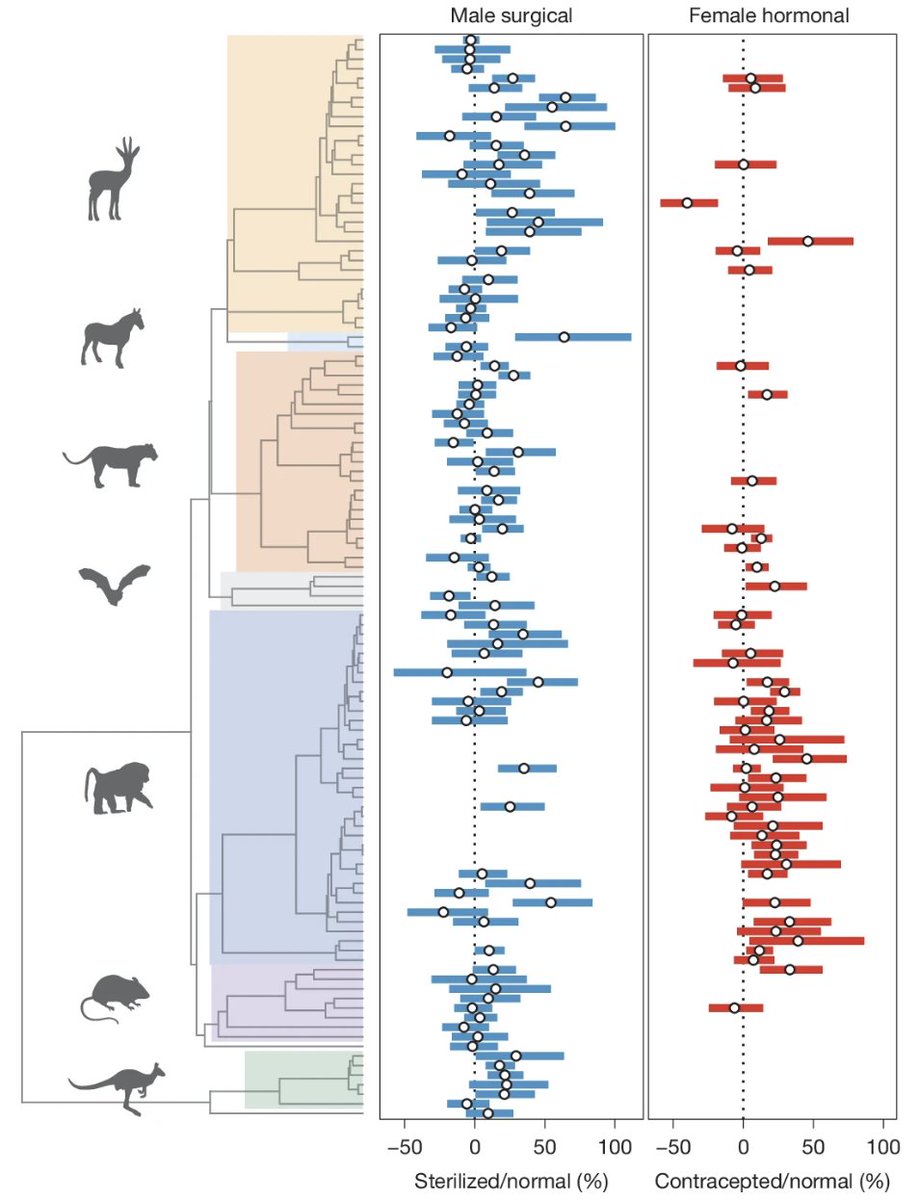
  10. Castration increases lifespan across vertebrates: Or at least, it feels longer.

  1. Pedagogy Recommendations:

    I think the single most thing important I can say is this: Every time you are inclined to use the word “teach”, replace it with “learn”. That is, instead of saying, “I teach”, say “They learn”. It’s very easy to determine what you teach; you can just fill slides with text and claim to have taught. Shift your focus to determining how you know whether they learned what you claim to have taught (or indeed anything at all!). That is much harder, but that is also the real objective of any educator.

  2. How Google Maps quietly allocates survival across London’s restaurants: It's amazing the rabbit holes people will go down.

    I needed a restaurant recommendation, so I did what every normal person would do: I scraped every single restaurant in Greater London and built a machine-learning model.

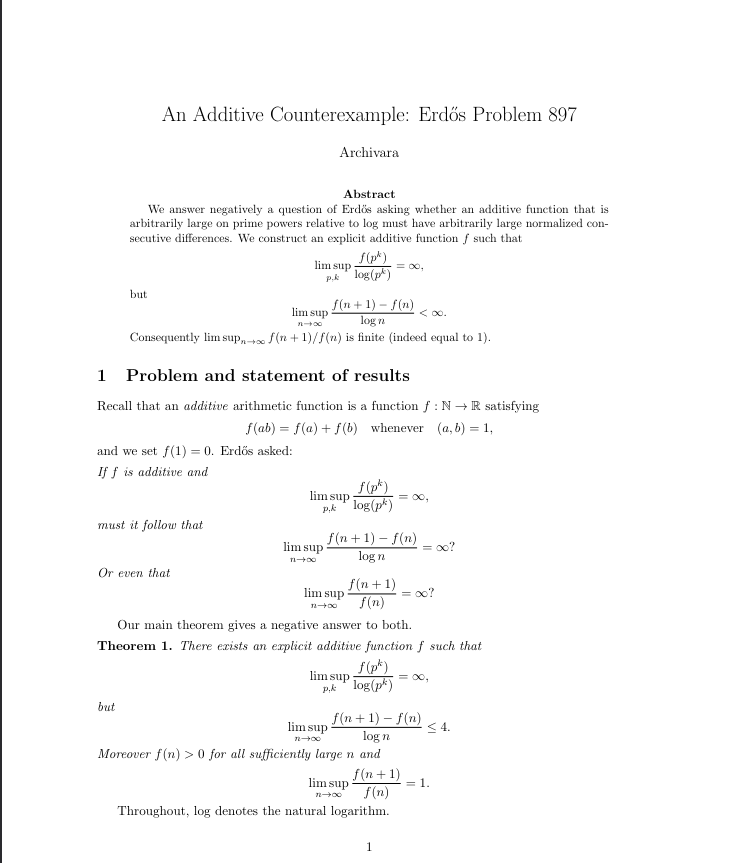
  3. I didn't think the current LLMs could solve "out-of-sample" problems, ones that are not in their training set. But I was wrong. And another one. These are hard problems from the looks of it.

  1. Automate your life with Claude Code:
  1. Copywriters reveal how AI has decimated their industry: It is coming for the white-collar jobs.

    AI is really dehumanizing, and I am still working through issues of self-worth as a result of this experience. When you go from knowing you are valuable and valued, with all the hope in the world of a full career and the ability to provide other people with jobs... To being relegated to someone who edits AI drafts of copy at a steep discount because “most of the work is already done” ...

  1. A curated list of the best finance blogs, tools, and webpages.

Links: Weeks of 15 & 22 Nov 2025

  1. The Algorithmic Turn: The Emerging Evidence On AI Tutoring That's Hard to Ignore: An excellent and balanced piece on impact of AI on education.

    The Harvard study was conducted using GPT-4 in autumn 2023; by the time the paper was published in 2025, the underlying technology had already advanced. If AI tutoring can produce effect sizes of 0.73 to 1.3 standard deviations now, whilst still requiring pre-written solutions and careful scaffolding to prevent errors, what happens when the models can reason through physics problems independently? When they can diagnose misconceptions in real time? When they can adapt not just to individual students but to culturally specific contexts?

    and

    Yet there is a troubling paradox at the heart of AI tutoring. The very same technology that can produce effect sizes above 0.7 standard deviations can also make students demonstrably worse at learning. And I would argue that the harmful version is the one most students are currently using today.

  2. If a bot passes your exam, what are you teaching?

    My Tools in Data Science course has a Remote Online Exam. It was so difficult that, in 2023, it sparked threads titled “What is the purpose of an impossible ROE?”

    Today, despite making the test harder, students solve it easily with Claude, ChatGPT, etc.

  3. The Effect of Video Watching on Children’s Skills:

    This paper documents video consumption among school-aged children in the U.S. and explores its impact on human capital development. Video watching is common across all segments of society, yet surprisingly little is known about its developmental consequences. With a bunching identification strategy, we find that an additional hour of daily video consumption has a negative impact on children’s noncognitive skills, with harmful effects on both internalizing behaviors (e.g., depression) and externalizing behaviors (e.g., social difficulties). We find a positive effect on math skills, though the effect on an aggregate measure of cognitive skills is smaller and not statistically significant. These findings are robust and largely stable across most demographics and different ways of measuring skills and video watching. We find evidence that for Hispanic children, video watching has positive effects on both cognitive and noncognitive skills—potentially reflecting its role in supporting cultural assimilation. Interestingly, the marginal effects of video watching remain relatively stable regardless of how much time children spend on the activity, with similar incremental impacts observed among those who watch very little and those who watch for many hours.

  4. Friction Was the Feature:

    There was a time when applying for a job meant choosing a handful of roles, tailoring a resume, and writing a real cover letter. The effort was a nuisance, but it quietly enforced focus. If you were going to burn a Saturday on an application, you probably cared about the job.

    Today, a candidate armed with an LLM can parse dozens of job postings, lift phrasing from each, and generate a set of keyword-optimized cover letters in no time. They can auto-tailor their resume to each posting. They can submit 30 applications in one sitting.

    This is better, right?

    Not for anyone, actually. Applications soar; recruiters drown. So we bolt on more automation: applicant tracking systems, resume parsers, AI interview schedulers. We convince ourselves we’ve built a better machine, but we haven’t redesigned the only machine that matters: the system matching the right people to the right work.

  5. Nano Banana Pro aka gemini-3-pro-image-preview is the best available image generation model: Read the whole thing and never believe an image again.

    That’s a pretty extraordinary result for such a simple prompt. The text is all spelled correctly and rendered without glitches. The content is solid too—it even included logos for the most popular publish platforms, and a tiny thumbnail of the Datasette UI which is close-enough for an infographic.

  6. Optimize your LinkedIn:

  1. The Constitution of Innovation:

    However around 1980, this unprecedented growth period ended. While the United States maintained a remarkably constant 2 percent growth rate in average income, the European core economies decelerated, slowly and then sharply. Since 1995, Europe’s average annual growth has been just 1.1 percent; since 2004, it has been a mere 0.7 percent – all while the United States has continued on its steady track. By 2022 the relative gap in output per head has returned to where it was in 1970. Decades of convergence were surprisingly wiped out.4

  2. Norway's Wealth Tax Unchains a Capital Exodus: Perhaps Norway needs to click the previous link.

    Norway's wealth tax increase, expected to raise $146M, led to a $448M net loss as $54B in wealth left the country, reducing tax revenue by $594M.

  3. ‘Are they going to eat me alive?’: trail runners become prey in newest form of hunting:

    Would you like to be chased by a pack of hounds? It’s a question often put to highlight the cruelty of hunting, because the answer would seem to be no. Or so you would think.

    Yet increasing numbers of people are volunteering to be chased across the countryside by baying bloodhounds in what could soon be the only legal way to hunt with dogs in England and Wales, rather than pursuing animals or their scents.

  4. She Took JPMorgan for $175 Million. That Doesn’t Include Her Restaurant Bills.:

    In September, Ms. Javice, 33, was sentenced to more than seven years in prison for fraud. In 2021, JPMorgan Chase acquired her start-up, Frank, for $175 million. Ms. Javice had claimed her company helped millions of people fill out their federal financial aid forms.

    After the acquisition, however, the bank discovered that she had lied about most of Frank’s customers. JPMorgan sued, and then prosecutors put Ms. Javice on trial. A jury convicted her this year.

    Along the way, Ms. Javice won a ruling that required the bank to pay her legal fees. JPMorgan has objected to the size of the fees in the past, and after her sentencing it decided to try to cut her off. The bank is trying the same maneuver with her former chief growth and acquisition officer, Olivier Amar, who was also convicted of fraud.

  5. Dog Accidentally Shoots and Injures a Pennsylvania Man, the Police Say: No comment.

    The man had been cleaning a shotgun and placed it on the bed shortly before it was fired. He received treatment at an area hospital.

Links: Week of 08 Nov 2025

  1. Brenda:

    I'm worried that they put co-pilot in Excel because Excel is the beast that drives our entire economy and do you know who has tamed that beast?

    Brenda.

    Who is Brenda?

    She is a mid-level employee in every finance department, in every business across this stupid nation and the Excel goddess herself descended from the heavens, kissed Brenda on her forehead and the sweat from Brenda's brow is what allows us to do capitalism. [...]

    She's gonna birth that formula for a financial report and then she's gonna send that financial report to a higher up and he's gonna need to make a change to the report and normally he would have sent it back to Brenda but he's like oh I have AI and AI is probably like smarter than Brenda and then the AI is gonna fuck it up real bad and he won't be able to recognize it because he doesn't understand Excel because AI hallucinates.

    You know who's not hallucinating?

    Brenda.

  2. Lovely Bakes, No Wig:

    Jasmine Mitchell, the winner of the 16th season of “The Great British Baking Show,” stood out in the competition mainly for her creations — including a cake that was nearly four feet long — but also for her statement earrings, brightly colored outfits and her shiny, hairless head.

  3. Optimists: In stock market there's a saying: Pessimists sounds smart, optimists make money. Turns out they live longer too.

    Optimism is a psychological attribute characterized as the general expectation that good things will happen, or the belief that the future will be favorable because one can control important outcomes. Previous studies reported that more optimistic individuals are less likely to suffer from chronic diseases and die prematurely. Our results further suggest that optimism is specifically related to 11 to 15% longer life span, on average, and to greater odds of achieving “exceptional longevity,” that is, living to the age of 85 or beyond. These relations were independent of socioeconomic status, health conditions, depression, social integration, and health behaviors (e.g., smoking, diet, and alcohol use). Overall, findings suggest optimism may be an important psychosocial resource for extending life span in older adults.

  4. Why I Stopped Being a Climate Catastrophist: Climate change seems quite visible. This year it rained in Indore through early November. In 90's and even early'00s anything beyond mid-September was extremely unusual. But is it catastrophic? Will it become so? Maybe not.

    Depending on how much weight one gives to individual studies and models, versus broader literature reviews and scientific assessments, you can find some evidence for some intensification of some features of tropical cyclone behavior and frequency in some places. But what you won’t find, Norris’ reference to a single unpublished and unpeer-reviewed study notwithstanding, is good evidence that climate change has affected those things very much.

  5. He’s Been Charged With Dozens of Crimes. Nobody Knows His Name.

    Investigators confirmed that the caller was actually Carl Avinger and that the defendant was not. Nor was he Carl E. Avinger, John Stamp, Bobby Jackson, Craig Taylor, Graig T aylor, Anthony S. Williams, Kevin C. Windley, Kevin Windleg, Corey Blake Duncan, Marco Ferrari, Marco Ferrare, Elvis Taylor or Elvis Teller — names he had used to commit dozens of crimes across the city, on Long Island and as far away as Oklahoma over the last three decades, according to court, jail and prison records, and internal Police Department documents obtained by The New York Times.


    In the months that followed, Melinda Katz, the Queens district attorney, and her prosecutors from the housing bureau unearthed more information about the man whose roughly half-century life had been defined by deceit. But there was one fact they had yet to discover: his name.

  6. UATX Is Ending Tuition Forever: Interesting but will it matter? See #7.

    UATX will never charge tuition. And we will never take government money.

  7. University education as we know it is over

    TL;DR: AI now solves university assignments perfectly in minutes. Students often use LLMs as a crutch rather than as a tutor, getting answers without understanding. To address these problems, I propose a barbell strategy: pure fundamentals (no AI) on one end, full-on AI projects on the other, with no mushy middle. Universities should focus on fundamentals.

  8. You Should Write An Agent:

    Some concepts are easy to grasp in the abstract. Boiling water: apply heat and wait. Others you really need to try. You only think you understand how a bicycle works, until you learn to ride one.

    There are big ideas in computing that are easy to get your head around. The AWS S3 API. It’s the most important storage technology of the last 20 years, and it’s like boiling water. Other technologies, you need to get your feet on the pedals first.

    LLM agents are like that.

    People have wildly varying opinions about LLMs and agents. But whether or not they’re snake oil, they’re a big idea. You don’t have to like them, but you should want to be right about them. To be the best hater (or stan) you can be.

    So that’s one reason you should write an agent. But there’s another reason that’s even more persuasive, and that’s

    It’s Incredibly Easy

  9. Game design is simple, actually:

    So, let’s just walk through the whole thing, end to end. Here’s a twelve-step program for understanding game design.

    One thing I have noticing recently is that there are a ton of interesting blogs out there. Of course, there is substack, but there is a lot more and of extremely high quality except that my discovery model has broken down. Twitter / Google are no longer the best discovery option. I would like a better solution to this problem.

Links: Week of 20 Sep 2025

  1. If you’ve got a compliment, just let it out.
  1. And the amazing thing is that the opposite works too!

    I think I mentioned this before but I was a national speech and debate octafinalist in high school and I was able to parlay that into a job running a debate program at an ambitious charter middle school in college.

    My approach was the exact opposite of this. Like half the kids were TERRIFIED of public speaking and were only doing it because their tiger moms insisted they had to (and the other half LOVED the attention).

    I had a lot of trouble getting the scared kids to open up and one day I asked one of the youngest ones what made her so afraid of speaking in front of the class, especially since they were all her friends.

    And she told me she was afraid she’d say something dumb or make a mistake and everyone would make fun of her. And that they’d laugh and laugh at her if she froze up.

    The next day I asked the class if anyone was scared of being made fun of and all the shy kids raised their hands.

    Now I don’t actually know if this is the same pathology in adults with fear of public speaking but I suspect it’s similar, and now I’ll get to how I addressed it which worked fabulously.

    First I told them that this was a ridiculous fear and that no one would make fun of them. But of course that doesn’t do anything lol. But then I told everyone to rip out 10 pieces of paper from their notebooks and crumple them up.

    And I told them I was going to give a speech. I told them if I said “uhh” or “um” or used any filler words they were to throw a paper ball at me and shout “shame!” 3 times pointing at me.

    And I gave a terrible speech. And they loved it! It was so much fun for them.

    But then! I had the students give speeches with the same rules, starting with the confident ones.

    After the third student the shy ones were volunteering.

    After the lesson I explained to them that we had accomplished 2 things:

    1. We had demonstrated how absurd such a reaction really is, because none of them would have ever reacted in that way if they weren’t specifically asked to, and none of them had any actual malice even when they did shout “shame” at their classmates

    2. Everyone had experienced the comically worst case scenario imaginable of public speaking and survived!

    So they became the rule during EVERY class and I was told by the other teachers that my shy students had started leading presentations and speaking up in class and some of them asked me how I worked with them.

    They were HORRIFIED when I told them lol.

    But it worked!

    This reminds me of Boggarts in the Harry Potter books.

  2. Church Planting: When Venture Capital Finds Jesus:

    This guy is founding an evangelical church, and I find his ecosystem fascinating. First for its stunning similarities to venture-capital-funded tech start-ups, and then for its simplicity and open-heartedness. None of the dynamics in church planting are unique or even particularly rare, but they are unobfuscated, and that makes church planting the equivalent of a large print book for the social dynamics that favor charismatic narcissists.

  3. Moon helium deal is biggest purchase of natural resources from space:

    Finnish tech firm Bluefors, a maker of ultracold refrigerator systems critical for quantum computing, has purchased tens of thousands of liters of Helium-3 from the moon — spending “above $300 million” — through a commercial space company called Interlune. The agreement, which has not been previously reported, marks the largest purchase of a natural resource from space.

  4. We Are Going to Have to Live Here With One Another (NYT): I try to avoid posting political or negative items but this was worth making an excception for. A long and insightful discussion between Ezra Klein and Ben Shapiro. Eye opening, if you read with an open mind.

  5. They traveled to Thailand. They wound up cyber scam slaves in Myanmar.: Scary. I am not sure I like graphical news but an interesting experiment.

  6. Teen depression has declined for the past 4 years, after peaking in 2021.:

  1. ICPC medals for OpenAI and Gemini:

    We received the problems in the exact same PDF form, and the reasoning system selected which answers to submit with no bespoke test-time harness whatsoever. For 11 of the 12 problems, the system’s first answer was correct. For the hardest problem, it succeeded on the 9th submission. Notably, the best human team achieved 11/12.

    We competed with an ensemble of general-purpose reasoning models; we did not train any model specifically for the ICPC. We had both GPT-5 and an experimental reasoning model generating solutions, and the experimental reasoning model selecting which solutions to submit. GPT-5 answered 11 correctly, and the last (and most difficult problem) was solved by the experimental reasoning model.

    and

    An advanced version of Gemini 2.5 Deep Think competed live in a remote online environment following ICPC rules, under the guidance of the competition organizers. It started 10 minutes after the human contestants and correctly solved 10 out of 12 problems, achieving gold-medal level performance under the same five-hour time constraint. See our solutions here.

Links: Week of 23 Aug 2025

  1. Why Is Martha’s Vineyard Going Vegan? It’s All About Tick Bites. (NYT):

    On the porch of the Chilmark General Store and at sunset-watching parties on Menemsha Beach, conversations circle ineluctably to the lone star tick, which after a single bite can leave people with a life-threatening allergy to most meat and dairy.

    Known as alpha-gal syndrome, the condition is changing the way many people shop, cook and eat in a place long known as a food-lover’s retreat for its thriving independent farms and restaurants. These new habits may prove to be lasting, as some islanders who initially avoided beef and cheese temporarily, out of necessity, later give them up for good out of preference.

    “It’s sort of supersized vegetarianism,” said Rebecca Miller, a farm owner who has the syndrome herself.

  2. Are Samosas Unhealthy? Some Indians Find Official Advice Hard to Swallow.:

    So, when a recent government advisory put samosas — along with other deep-fried Indian snacks and Western foods such as burgers and French fries — on a list of things that should be eaten in moderation because of their high oil and sugar content, there was an unsurprising outcry. Social media erupted with memes, and Indian media chimed in to say the country’s most iconic bites were under attack.

  3. @rivatez:

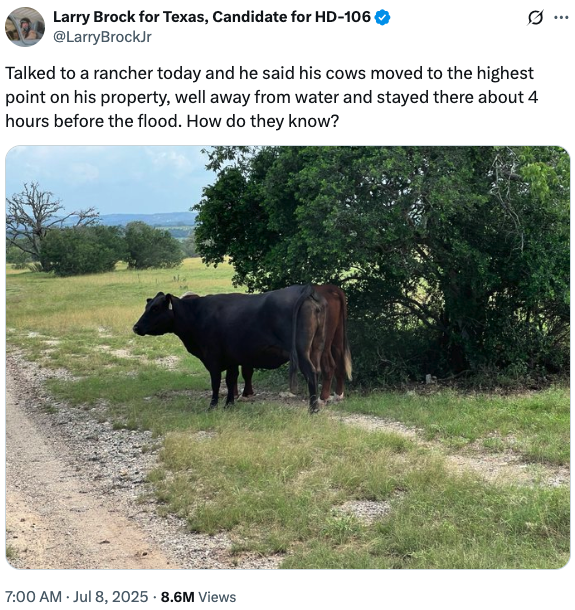
    That animals seemingly anticipate events should humble us more. Changes in groundwater chemistry, electromagnetic fields and sound waves make animals restless, distressed and even relocate

    In the West it is seen as ‘woo’ to contemplate that energy/weather humans don’t consciously experience can affect our psychology, and yet we forget that we are animals too.

    Even outside extreme weather events, the lunar cycle moves oceans, huge bodies of water. We are, like all animals, primarily made of water. The word ‘lunacy’ comes from the ancient understanding that our minds can be affected by it

    An interesting experiment is to log your daily mood for a few months- ups and downs, anxiety / joy levels, big arguments with loved ones etc. Then afterwards, retroactively chart it against lunar cycles and NASA space weather data that tracks geomagnetic storms, solar flares etc.

    Be open- minded and try it. I, too, used to think this stuff was BS

    Now I think much of modern psychiatry is giving people drugs to tune down people’s individual responses to these external inputs, eg ‘bipolar’ might just indicate high sensitivity

    How many important scientific breakthroughs lie on the other side of our collective dismissal of ‘woo’?

    cows
  4. Why I believe in AGI (again):

    First, I’m now convinced that ChatGPT understands what it reads. Second, reasoning models persuade me that ChatGPT is creative. Third, ChatGPT summarizes texts extremely well, which I believe to be a robust measure of intelligence.

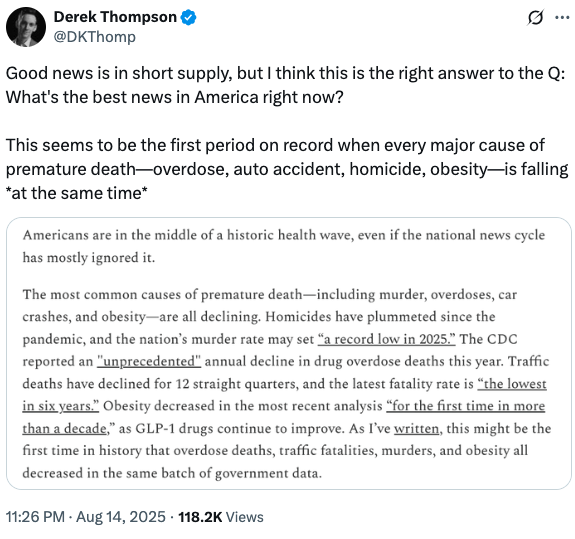
  5. Derek Thompson: Good News

    "The better news is that this is happening at a time when exercise seems to be increasing for many groups, especially the young and old. The bad news is ... deep Medicaid cuts and declines in childhood vaccine uptake are not exactly optimistic predictors of American health."

  6. Your Review: Dating Men In The Bay Area: Not what it says on the label at all! Recommended.

  7. Adults Are Going to Sleep-away Camp to Make Friends. It Seems to Actually Work.:

    “Anyone that has worked at camp or grown up in the camp world understands there is a powerful people connection that forms at camp,” said Liam Macleod, a longtime camp professional and marketing director at Camp No Counselors. “It’s camp magic and it’s hard to replicate in the regular world.”

  8. What is the most profitable thing you have done with ChatGPT? on Reddit via Simon Willison: In dollar terms, probably crafting fundraising messages for charity event organized by my Alumni Association. In real terms, physiotherapy for my back and legs. So far. Some great examples at the link. Failure of imagination remains the biggest hurdle in getting value from LLMs.

  9. AI Is Designing Bizarre New Physics Experiments That Actually Work:

    It took months of effort to understand what the AI was doing. It turned out that the machine had used a counterintuitive trick to achieve its goals. It added an additional three-kilometer-long ring between the main interferometer and the detector to circulate the light before it exited the interferometer’s arms. Adhikari’s team realized that the AI was probably using some esoteric theoretical principles that Russian physicists had identified decades ago to reduce quantum mechanical noise. No one had ever pursued those ideas experimentally. “It takes a lot to think this far outside of the accepted solution,” Adhikari said. “We really needed the AI.”

  10. GPT-5 prompting guide:

    GPT-5, our newest flagship model, represents a substantial leap forward in agentic task performance, coding, raw intelligence, and steerability.

    While we trust it will perform excellently “out of the box” across a wide range of domains, in this guide we’ll cover prompting tips to maximize the quality of model outputs, derived from our experience training and applying the model to real-world tasks. We discuss concepts like improving agentic task performance, ensuring instruction adherence, making use of newly API features, and optimizing coding for frontend and software engineering tasks - with key insights into AI code editor Cursor’s prompt tuning work with GPT-5.

    We’ve seen significant gains from applying these best practices and adopting our canonical tools whenever possible, and we hope that this guide, along with the prompt optimizer tool we’ve built, will serve as a launchpad for your use of GPT-5. But, as always, remember that prompting is not a one-size-fits-all exercise - we encourage you to run experiments and iterate on the foundation offered here to find the best solution for your problem.

    And a tutorial by Anthropic.

  11. Class Dismissed: Alpha School is getting a lot of coverage all of a sudden. Long piece about the people and the tech behind it.

Links: Week of 09 Aug 2025

  1. How to Teach Your Kids Poker, the Easy Way:

    The right way to begin is with one-card poker. Everyone antes one chip and gets one card, face down. You look at your card. There’s a single round of betting, which proceeds around the table: If no one else has bet, you can bet or check (do nothing); if anyone in front of you has bet, you can call (or match the bet), raise or fold. When everyone has called the last bet or folded, those who are left in the hand show their card. The highest card wins: Ace is highest, then king, so on down to two.

    That’s it. No pairs, no flushes, no full houses, no complicated order of hands to remember, though you do have to remember that a queen beats a jack. But you learn a lot of poker. You will always win with an ace, but you have to learn to maximize the value of your ace, to induce other people to bet into you and call your raises. One of my proudest moments as a parent was when my daughter first check-raised me with an ace.

    You’ll probably win with a king, but if someone raises you, does that mean that they have an ace (and have you beat), or a queen (and are overconfident), or a six (and are bluffing)? There are 52 cards, so you can estimate the probabilities if you are mathematically inclined, though if you are four you probably won’t.

    You probably won’t win with a six, but if you bet it confidently you might bluff everyone else out. If everyone else checks, and you’re the last person to bet, you might as well bet: You have “position,” everyone else has a weak hand, and you might be able to steal a pot. The essentials are there.

    Once the kids have mastered this, you can introduce the order of hands gently with two-card poker. (Any pair beats a high card, highest pair wins.) Then teach the rest with five-card straight poker. This isn’t a great game, but it’s a brief stopover on the way to five-card draw, which is a perfectly respectable poker game. Texas hold’em is not far behind.

  2. My Father's Instant Mashed Potatoes:

    The chuño-chomping Incans were not the last military to rely on dehydrated potatoes for sustenance. In World War II, the US Army experimented with various forms of potato dehydration to help stretch supply lines. The easiest way to get a uniform potato commodity into the hands of G.I.s was to pulverize the potatoes into granules, dehydrate them, and then plan on bringing them back to life with boiling water in an imitation of “mashed potatoes”.

    Deeper than I would have imagined from the title.

  3. A lot more than you wanted to read on College and College Admissions. Depressing.

  4. The Imitation Game: Defending against AI's Dark Side!:

    A few weeks ago, I started receiving a stream of message about an Instagram post that I was allegedly starring in, where after offering my views on Palantir's valuation, I was soliciting investors to invest with me (or with an investment entity that had ties to me). I was not surprised, since I have lived with imitations for years, but I was bemused, since I don't have an Instagram account and have not posted on Facebook more than once or twice in a decade. In the last few days, those warnings have been joined by others, who have noted that there is now a video that looks and sounds like me, adding to the sales pitch with promises of super-normal returns if they reach out, and presumably send their money in. (Please don't go looking for these scams online, since the very act of clicking on them can expose you to their reach.)

    It was a matter of time.

  5. GPT-5: It Just Does Stuff:

    GPT-5 just does stuff, often extraordinary stuff, sometimes weird stuff, sometimes very AI stuff, on its own. And that is what makes it so interesting.

    To be clear this wasn't my experience. I gave it a PDF and asked it to estimate something based on the data in the file. It made up all the numbers and suggested they were in tables and pages that didn't exist in the PDF. I was not able to get it focused on the actual information in the PDF despite multiple reminders and other attempts. Apparently though, there was a bug in their system yesterday that made it appear dumber. I will try again.

Links: Week of 01 & 08 Jun 2025

  1. More kids are beating cancer. Improving the rest of their lives is next. (WaPo)

    When oncologists gave my 5-year-old daughter the all-clear from high-risk neuroblastoma in 2010, I breathed a sigh of relief.

    But her health needs were just beginning.

    Fifteen years later, the intense and often toxic treatments that saved Emily’s life have left her with a host of lifelong health challenges — hearing loss, stunted height, endocrine and kidney dysfunction, and permanent hair-thinning — issues no one talked about during her 18 months of cancer treatment.

    A good problem to have from one perspective but no less hard to deal with.

  2. Questions about AI 2025:

    My working hypothesis is that human cognition improves markedly once pen is put to paper, and in some cases can continue to improve with extended writing (but note many prominent failures).

    This is correct and yet I do this less than I should. Time to commit to writing non-link posts weekly?

  3. Exact Instructions Challenge (YouTube): Fun.

  4. A ‘Mission: Impossible’ Fan Favorite Returns 3 Decades Later. Even He’s Surprised. (NYT)

    But according to the “Final Reckoning” director Christopher McQuarrie, Donloe made a big impact. In fact, he said in an interview, fans frequently asked him when he was going to bring the character back. For a long time, he didn’t understand why Donloe engendered such love, until he heard the question framed in a different way: “When is the team going to do right by what they did to Donloe?”

    “And I realized why William Donloe resonated,” McQuarrie said. “There was a perceived injustice, whether anybody could put their finger on it or not.”

  5. The Rise of the Japanese Toilet (NYT):

    In 1982, a peculiar commercial aired on televisions across Japan.

    An actress in a pink floral dress and an updo drops paint on her hand and futilely attempts to wipe it off with toilet paper. She looks into the camera and asks: “Everyone, if your hands get dirty, you wash them, right?”

    “It’s the same for your bottom,” she continues. “Bottoms deserve to be washed, too.”

    Civilization on the march.

  6. Zarna Garg Went From Stay-at-Home Mom to Stand-Up Comedian (NYT):

    After 16 years focusing on her husband, Shalabh, and her three children — Zoya, Brij and Veer — Ms. Garg re-entered the work force in 2019, but not to return to her erstwhile career as a personal injury lawyer. Instead, encouraged by her children, she started working the New York open-mic circuit and performing at Westside Comedy Club before headlining at Caroline’s on Broadway by 2020.

    In 2023, she talked her way into opening for Tina Fey and Amy Poehler on their Restless Leg Tour, and Prime Video aired her special “One in a Billion.” This spring, she made her film debut in the critically acclaimed rom-com “A Nice Indian Boy.” Her second special, “Practical People Win,” will air on Hulu in July, and she is developing a sitcom called “Zarna” with Mindy Kaling and Kevin Hart.

  7. The Lightcone Podcast on Prompting (Video Podcast): I am hungry for more such reources.

  8. Chattel Childhood: Trigger warning - fairly explicit start and parts.

    I don’t approve of the Simbari childrearing, not because I think the pain and disgust of what the children are forced to do is inherently bad, but because they are forced.

    To love someone skillfully is to pour fuel on their soul. It’s to see the world through their desire, to delight in it, and go “I desire you to get what you want.” It is the amplification of their will.

    The Simbari people are destroying the will of their children. My parents destroyed my will. And I think, quite seriously, that our current culture is likewise destroying the will of its children en masse. That’s what you do to property.

    Worth thinking about although largely I don't agree with this. Her will seems to be doing just fine.

    I think humans are are social animals and whether something traumatizes us or not is often (but not always) a function of the social context surrounding the event. What happens to the Simbari children (if it in fact, does happen. I have not verified or heard of this before) doesn't traumatize them because everyone around them considers it perfectly normal.

    In my mental model, the trauma happens, when you feel something shameful or otherwise different has happened to you and everyone looks at you different.

  9. Artichokes: For the photos.

  10. High cost of building in US:

    Zuckerburg's worth is 226 billion. The NY Subway builds tunnels at $4 bil. per mile. SF's BART builds subways at $2 bil. per mile. It's crazy that all of Zuckerberg's wealth would build just 8% of the current NYC subway network.

    Meanwhile in Paris cost $250 mil. per mile.

  11. UFO?:

    The object was precognitive in behavior. The radar data from the SPY-1B system showed that the Tic Tac descended from 28,000 feet to sea level in 0.78 seconds, a feat requiring acceleration up to 5,880 Gs. But here's what no one focuses on: that data was correlated by both radar and infrared, meaning this was not a sensor glitch or hallucination...it was a multi-spectrum-confirmed, real-world event. And what’s worse? The object decelerated to a dead stop… mid-air. Bonkers!

Links: Week of 25 May 2025

A long list today because this week two of my top sources were on fire - MR and NYT.

  1. My Parents Expected to Be Retired. Instead, They Are Raising My Sister’s Kids. (NYT): Beautiful, heartbreaking and uplifting.

  2. Still booting after all these years: The people stuck using ancient Windows computers: None of the above. Well... maybe heartbreaking. No need to click the link though, the title says it all.

  3. Measles cases in Europe, the Americas skyrocket: This is infuriating for two reasons. The second reason is that you wouldn't know it from reading most news that Europe has 10x the cases of USA. NYT I can understand, but I had to scroll down 3 pages on BBC website, after searching for "measles" to find a story about something other than RFK Jr. and Texas moms.

  4. Your Fingers Wrinkle in the Same Pattern Every Time After Long Exposure to Water: Heh. Also apparently they wrinkle to improve underwater grip, not because the skin expands by absorbing water, which would have been hypothesis.

  5. How Miami Schools Are Leading 100,000 Students Into the A.I. Future (NYT)

  6. 5 weeks ago, someone buried a 22 lb chest with $10,000 of prizes (half in gold), somewhere in San Francisco. No one has found it yet. This is the only clue. It was found within a day of this post, so clearly the only thing holding back the search was the number of eyes looking. How many other problems is this true for?

  7. "One of main goals in life has been to make my parents proud". 92% in Iraq, 78% in India. I remember realizing sometime in my early 30s that my parents didn't know the hierarchy of success in my field. As far as they were concerned I was already successful after college and any "actual" success wouldn't register with them. I felt the void in my movtivation for quite some time. Having your own kids helps with the transition.

  8. AI & Critical Thinking:

    An interviewer just asked me what skills AI will make more important. My response? Critical thinking skills.

    This is because in the past there was value in creating large quantities of information. That is now costless. The new currency is how to generate, assimilate, interpret, and make that large amount of information actionable.

    The next question then becomes how do we teach, and improve our own, critical thinking skills? I discuss that in a recent study where I create a critical thinking skills hierarchy.

  9. The Agentic Web and Original Sin: I have been wondering about this problem for a while - who puts up the content for the LLMs to train on if everyone gets their answers from the chatbots and doesn't visit websites anymore.

    The problem, as both I and Patel noted, is that this ecosystem depends on humans seeing those webpages, not impersonal agents impervious to advertising, which destroys the economics of ad-supported content sites, which, in the long run, dries up the supply of new content for AI.

    A potential solution:

    First, the protocol layer should have a mechanism for payments via digital currency, i.e. stablecoins. Second, AI providers like ChatGPT should build an auction mechanism that pays out content sources based on the frequency with which they are cited in AI answers. The result would be a new universe of creators who will be incentivized to produce high quality content that is more likely to be useful to AI, competing in a marketplace a la the open web; indeed, this would be the new open web, but one that operates at even greater scale than the current web given the fact that human attention is a scarce resource, while the number of potential agents is infinite.

  10. Cargo Ship Crashed Into Man’s Yard After Crewman Fell Asleep, Police Say (NYT)

  11. The 22 Best Pizza Places in New York Right Now (NYT)

  12. New Studies Dismiss Signs of Life on Distant Planet (NYT): Dang.

  13. SEO for AI: A look at Generative Engine Optimization

  14. The best bookstore in NYC, and then some

  15. They’re 15. Wait Until You Read Their Newspaper. (NYT):

    “We still haven’t done hot dogs,” Teddy said. Billy agreed: Hot dogs should be an editorial priority.

    and

“We were still very young; we had no idea what we were doing,” said Billy, a junior varsity quarterback whose hair was tousled into a cruciferous mop.

  1. Know hope!

    …Use of digital technologies was associated with reduced risk of cognitive impairment (OR = 0.42, 95% CI 0.35–0.52) and reduced time-dependent rates of cognitive decline (HR = 0.74, 95% CI 0.66–0.84). Effects remained significant when accounting for demographic, socioeconomic, health and cognitive reserve proxies.

    Paper here.

  2. Putting Claude 4 Opus in an open playground to chat with itself led to it diving into philosophical explorations of consciousness, self-awareness, and by 30 turns it eventually started using Sanskrit: Can't wait till nationalist politicians from my home state get their hands on this. Sanskrit!

  3. Toronto burger shop called Good Fortune Burger renamed its menu items to sound like office supplies, helping remote workers potentially expense meals through work accounts. The "basic steel stapler" and "braided HDMI cord” are popular. : As a reply points out this doesn't make sense because the order is still from a place called Good Fortune Burger.

  4. Who Benefits from Surge Pricing?:

    What are the welfare effects of surge pricing? Using Uber data, I develop an empirical model of spatial equilibrium composed of demand, supply, and matching. I find that surge pricing raises total welfare, benefitting riders but hurting drivers.

    Welfare effects differ substantially across sides of the market: rider surplus increases by 3.57% of gross revenue, whereas driver surplus and the platform’s current profits decrease by 0.98% and 0.50% of gross revenue, respectively.

    This doesn't make sense. If it hurts the platform or the drivers, why would they do it?

    After dropping the pearl of wisdom above, I decided to actually read the paper. In the first two pages I found this:

Uber’s current profits decrease by 0.50% of gross revenue. This probably does not mean that Uber is hurt, but rather that it is willing to forgo current profits to increase rider surplus—the right choice if it believes that long-run shareholder value is more closely tied to rider surplus and customer retention than to current profits.

Makes sense. After this my eyes glazed over and I dropped the paper in Claude and asked it why drivers would participate in this. Here's what it says: 

The paper acknowledges this is the more problematic finding. "My findings suggest that drivers might have good reason to complain. Their hourly earnings are not much higher than the minimum wage, so even the small effects I find might be a concern."

However, drivers may not have full information about the counterfactual (uniform pricing), and many drivers are part-time workers using Uber for supplemental income rather than as their primary employment.

Links: Week of 30 Mar 2025

  1. Unintentionally hilarious:

    The Danish Defense Ministry also plans to fund two more dogsled teams to protect the 375,000-square-mile Northeast Greenland National Park, the largest in the world. These would be the hardcore Sirius patrols, viewed by the Danes as the Navy SEALs of the Arctic, which began operations during World War II.

    Two. Not one.

  2. How to vibe code?: A fairly decent app and when you see his conversations with ChatGPT, its mostly just plain english. Does a programming background help. Sure, but you can go quite far without any. Here are the actual conversations:

    a. Starting the app

    b. Enhancements

    c. More enhancements

    d. Deploy to iPhone

    e. The actual App

  3. Why we ended up homeschooling:

    TL;DR: homeschooling makes it much easier to individualize education, which makes it more efficient and meaningful.

  4. Tokyo vs. Rest of Japan:

    This is called the sponge city effect in my little world of demographics. In a declining region we often see the biggest city soaking up population since jobs and health services etc cluster in a single area rather than spreading out. Japan has been shrinking for three decades while Tokyo happily grows.

  5. How Much Would You Need to be Paid to Live on a Deserted Island for 1.5 Years and Do Nothing but Kill Seals?: What it says on the label.

  6. Best take:

    people are rightfully upset about this atlantic story because it gets at a truly alarming issue: being added to large, ongoing group texts without consent

    😂

  7. True that!:

    Your brain will invent fake problems for you if you don't go out and find real ones

  8. I don't know if this is the right path, but its the right destination

Links: Week of Mar 08 2025

  1. James Harrison: The Man Who Saved 2.4 Million Babies: Hall of Fame.
  2. Coincidentally, this week both Tyler Cowen and Karthik S shared memories of playing card games as kids. And then today my sister mentioned my younger newphew had started playing Dungeons and Dragons recently. We have played card games and board games with our boys, especially during COVID and it was fun. Clearly we should do more of this.
  3. Another entry to the hall of fame. A different hall, sure, but come one, clearly this guy is a legend.
  4. A different way of learning math? Via Zvi, who belongs in a third hall. Can't fault him for lacking ambition but perhaps this is the rare tweet that should have been an article.
  5. A Cheeto Shaped Like the Pokemon Charizard Sells for Nearly $90,000. NYT Paywall but do you really need to read anything else?
  6. Honey on a razor blade: Something about the actual visualization struck a chord with me.

Links: Week of 03 Feb 2025

Most books should have been blog posts, most blog posts should have been tweets and most tweets should never have been written. - Unknown Tweeter

Another set of AI-heavy links. I can’t help myself right now.

  1. Set up a fake cricket league:

    These arrangements might have suggested that the league featured professional-grade cricket that an online audience would find worth watching, but in fact, the players weren’t established cricketers or even skilled amateurs. They were locals that Davda had recruited with the promise of paying 400 rupees (about £3.50) per day — twice what people in the area make in daily wages working on farms and for local businesses.

    Respect.

  2. How to choose a religion (NYT Paywall):

    But for the general obligation imposed upon us all, as time-bound creatures in a world shot through with intimations of transcendence, a different Eliot line is apt: “For us, there is only the trying. The rest is not our business.”

    I didn’t know Eliot plagiarized The Gita. The book is called Believe: Why Everyone Should Be Religious. I hope to read this book.

  3. I am (not) a Failure: Lessons Learned From Six (and a half) Failed Startup Attempts. I am a sucker for these stories, having a failed startup in my recent past. The conclusion conveniently helps me feel good about the failure.

  4. Agency:

  1. How to prepare for an AI future: Coincidentally, I ran into a number of pieces on this topic last week. The first one from Tyler Cowen and the second from Nate Silver. Both have the same advice in the first place: use LLMs more than you do and for more things than you do.

  2. Using AI to build a nuclear fusor: Combining the wisdom of the previous two links.

  3. Using AI to improve learning: I would love to see how the tutor was created. Perhaps I, too, need to take the advice from links 4 & 5 and do this project myself.

Spaced Repetition

What is Spaced Repetition (SR)?

Claude says:

Spaced repetition is a learning technique that involves reviewing information at gradually increasing intervals. Here's how it works:

When you first learn something new, you review it fairly soon (like the next day). If you remember it well, you wait a bit longer before the next review (maybe 3 days). If you still remember it well, you extend the interval further (perhaps a week, then two weeks, then a month).

The key principles behind spaced repetition are:

  1. The spacing effect: Information is better remembered when studying is spread out over time rather than crammed into a single session.
  2. The testing effect: Actively recalling information strengthens memory more effectively than passive review.

This may not sound revolutionary. After all, some version of this is how we prepared for our exams. But the important thing is that unlike the 90s, there’s an app for that (Anki, Mochi & others). The app handles the spacing and repetition, making it more practical, reliable and scalable.

When I first learned about and used SR apps years ago, I thought, “Wow! It would have been great to have this in school. This will be great for the boys in a few years.”

I never used the technique until last year when I used Anki for homeschooling the kids in Hindi. You can get many ready-made decks (free & paid) on the Anki website, but creating your own (necessary for specific requirements) was a chore, and I stopped after a few months.

I thought SR was for students until I saw a Dwarkesh Patel podcast with Dan Shipper using it to learn more broadly. It wasn’t limited to coursework or vocabulary but included concepts. He claims it allows for better understanding of linkages and patterns over time.

But what had my jaw drop was that he used Claude / ChatGPT to create the cards! Of course. Just throw in the material you are learning into Claude, ask it to create SR cards for the material and you’re done.

It may need some editing or creating additional cards, but it’s generally good enough. It can even output in Anki file format. Rope in an AI and the amount of knowledge you can include in your SR system just explodes.

While researching this piece, I revisited Alexey Guzey’s original post that introduced me to the concept. I didn’t remember this, but the first thing he talks about is to use SR for instilling novel thought patterns.

Front card: saying no

Back card: If I want to say no, I will stop and make sure this is not just status quo bias (coz it probably is)

Status quo bias sucks. Does this one solve it? Beautifully so. Although several months had passed before it finally kicked in, the number of times I noticed saying “no” out of status quo bias, then having this thought come up and make me retroactively reverse the initial “no” is in the tens already.

Will this work? I am not sure, but between how Dwarkesh is using SR and this, I feel the case for having my own SR system is growing stronger. Hopefully, I’ll have an update in a few weeks.

How do you train?

Tyler Cowen’s post inspired by David Perell planted another bug in my brain.

“Athletes train. Musicians train. Performers train. But knowledge workers don’t.”

Recently, one of my favorite questions to bug people with has been “What is it you do to train that is comparable to a pianist practicing scales?”

If you don’t know the answer to that one, maybe you are doing something wrong or not doing enough. Or maybe you are (optimally?) not very ambitious?

Here’s his answer. Of course, I didn’t know the answer to that one.

Watching Andy Matuschak study Quantum Mechanics with Dwarkesh Patel (who else?) led to a few realisations.

Having the right tools and workflows and being good at them is a huge productivity unlock. In the video, Andy uses custom software that allows him to do much more, faster. He reads, creates SR cards, and reviews material on the fly.

He also knows how to put mathematical symbols in his notes, making useful cards so much more quickly.

What is the difference in learning between someone manually revising from a textbook before an exam (as I used to do) and someone using a custom SR system, AI-generated SR cards, and a workflow to push those cards daily? Huge.

This year, I plan to practice getting better with the keyboard. How long can I work on my desktop without touching the mouse? To switch between windows and apps, and use functions within apps?

Sure, I can do Ctrl + C and Ctrl + V. But can I effortlessly do Alt + E + S + V + F (Paste Special > Formulas in Excel)? Can I do 50 other menu actions across multiple programs? Can I set up workflows for routine processes and use AI to automate?

The second thing that struck me was the depth of his learning approach. Sure, it’s a tough topic, but he spent 20+ min on the first page, asking questions, drawing connections, testing himself, and revising. I don’t recall engaging with my coursework so diligently.

The last thing that occurred to me is how important and hard it is to learn these hacks/tricks/workflows. Some people just know and others never do.

Here’s a great resource for this “tacit knowledge.” I’m glad someone recognised the importance of the concept, named it, and created a knowledge base.

×