Posts tagged "health"

18 posts

Links: Weeks of 22 Feb 2026

AI Links
  1. The singularity won't be gentle:

    If AI has even a fraction of the impact that many people in Silicon Valley now expect on the fabric of work and daily life, it’s going to have profound and unpredictable political impacts.

  2. Rebuilding our world, with reference to strong AI:

    When 2012 passed into 2013, we did not have to rebuild our world, not in most countries at least. It sufficed to make adjustments at the margin.

    After the Roman Empire fell, parts of Europe had to rebuild their worlds. It took a long time, but they ended up doing pretty well.

    After the American Revolution, the newly independent colonies had to rebuild their own world. They did so brutally, but with considerable success.

    After WWII, Western Europe had the chance to rebuild its own world, and did a great job.

    We moderns are not used to having to rebuild our world.

    It is now the case that strong AI is here/coming, and we will have to rebuild our own world. Many of us are terrified at this prospect, others are just extremely pessimistic. It seems so impossible. How are all the new pieces supposed to fit together? Who amongst us can explain that process in a reassuring way?

    Yet we have done it many times before. Not always with success, however. After WWI ended, Europe was supposed to rebuild its own world, but they came up with something far worse than what they had before. Nonetheless, in the broader sweep of history world rebuilding projects have had positive expected value.

    And so we will rebuilding our world yet again. Or maybe you think we are simply incapable of that.

    As this happens, it can be useful to distinguish “criticisms of AI” from “people who cannot imagine that world rebuilding will go well.” A lot of what parades as the former is actually the latter.

    In any case, it all will be quite something to witness.

  3. Death of Software. nah.:

    Strap in. This is the most exciting time for business and technology, ever.

  4. AI Doesn't Reduce Work - It Intensifies It:

    I think we've just disrupted decades of existing intuition about sustainable working practices. It's going to take a while and some discipline to find a good new balance.

  5. Seb Krier: Some of this was weirdly scary.

  1. Family deepfakes help people celebrate and grieve in India:

    When the lights dimmed at Jaideep Sharma’s wedding reception in the north Indian city of Ajmer, guests expected to see a cheesy montage of the young couple in various attractive locations. Instead, they saw Sharma’s father — dead for more than a year — on the screen, smiling and blessing the newlyweds.

  2. I spent $10,000 to automate my research at OpenAI with Codex

  3. My AI Adoption Journey

  4. Agent Skills with Anthropic

Other Stuff
  1. ‘They All Tried to Break Me’: Gisèle Pelicot Shares Her Story: Words fail me.

    I think we’re going to do great things together. I think we’ll make the most of these beautiful years we have left, and I hope they’ll last very long.

    Amen.

  2. Navigating ER / Hostpital in US:

    The most important thing I've learned about hospitals over the last decade: if your loved one needs to be admitted to the hospital, chances are they will get incredible care... as long as that care can be immediately administered in the ED.

    However, if they need to move outside the ED, you must learn as much as you can so you can help expedite the process, advocating to them to get to where they need to go — usually an inpatient floor, as quickly as possible.

    The stakes are probably higher than you think.

  3. The Economics of a Super Bowl Ad:

  1. Codex:

    No, this is not an AI post. Codex is a NYC bookshop at 1 Bleecker St., at Bowery. It is quite extraordinary in its curation of used books. The fiction section is large, yet you can pick up virtually any title on the shelves and it is worth reading. A wonderful place to go to get reading ideas, plus the prices are reasonable and the used books are in decent shape. Such achievements should be praised.

  2. Record Low Crime Rates Are Real, Not Just Reporting Bias Or Improved Medical Care:

    This post will do two things:

    1. Establish that our best data show crime rates are historically low

    2. Argue that this is a real effect, not just reporting bias (people report fewer crimes to police) or an artifact of better medical care (victims are more likely to survive, so murders get downgraded to assaults)

  3. Rob Johnson:

  1. What it was like to be a bush at Bad Bunny’s Super Bowl performance:

    Some of the biggest stars to emerge from this year's Super Bowl halftime show never even showed their faces on camera. They were the ones who dressed as bunches of grass to transform a football stadium into the sugarcane fields of Puerto Rico.

Links: Weeks of 20 & 27 Dec 2025

A long one to mark a year of link posts. Starting with feel-good stories for the festive season.

  1. The best story you’ll read this Christmas. Truly.
  1. Your Social Muscles Are Wasting Away. Here Is How to Retrain Them.: Everything old is new again and the search for connection is timeless.

    I’m a married 41-year-old woman who lives with housemates by choice. Rather than trying to acquire as much space and privacy as we could as quickly as we could, my husband and I decided to do the opposite. Parenting in our mid-30s, bursting out of our small London flat, we rented and then bought a London home with another couple.

  2. Sisters in Sweat: A couple years ago I played soccer every saturday morning, for about a year. Great memories. I get this. New year resolution.

    SiS has become a lifeline for thousands of women like Almeida in India, helping build a rare space where sport turns into an experience of liberation and camaraderie.

  3. How I read: I have stopped reading long form for a while, so I am a sucker for these guides. Not a New Year resolution though.

    One of the many joys of living in New York City is the library system. The Performing Arts Library and Stavros Niarchos Foundation Library (on Fifth Ave across from the main branch) are both delightful places to spend a few hours in Manhattan, and in Brooklyn I spent more than my fair share of afternoons at the Grand Army Plaza main branch. I pick a section and walk the shelves until I get hungry, thirsty, or under-caffeinated.

  4. I count AI summarized books as “Read”: Possibly a New Year resolution.

    I upload books to Claude and ask it to “Comprehensively and engagingly summarize and fact-check, writing in Malcolm Gladwell’s style, the book …”. I can read it in an hour instead of twelve. Four bullet points instead of forty. With (this surprised me) roughly the same number of insights I actually do something with.

  5. Ruby's Ultimate Guide to Thoughtful Gifts: New Year resolution?? Who am I kidding?

    Give a man a gift and he smiles for a day. Teach a man to gift and he’ll cause smiles for the rest of his life.

  6. The Lost Generation: Tough reading.

    At the time, I blamed those women. Of course I did. They’ve since ascended the TV ladder and work as co-executive producers on major shows. On some level, even today I can’t help but think: That could have been me. That should have been me.

    But those women didn’t take our jobs any more than the 50-year-old Hollywood lifers had. The lifers were still there. They’re still there. And I’m not angry at the women and people of color who made it instead of me—people have the right, in most cases the responsibility, to take the opportunities that are offered them—or even at the older white guys who ensured that I didn’t.

  7. Paranoia: A Beginner's Guide: Worth reading just for the first line.

    People sometimes make mistakes. (Citation Needed)

  8. Chemical hygiene: A good follow up to the previous link?

  9. How Did the C.I.A. Lose a Nuclear Device? Where else but in India?

    A plutonium-packed generator disappeared on one of the world’s highest mountains in a hush-hush mission the U.S. still won’t talk about.

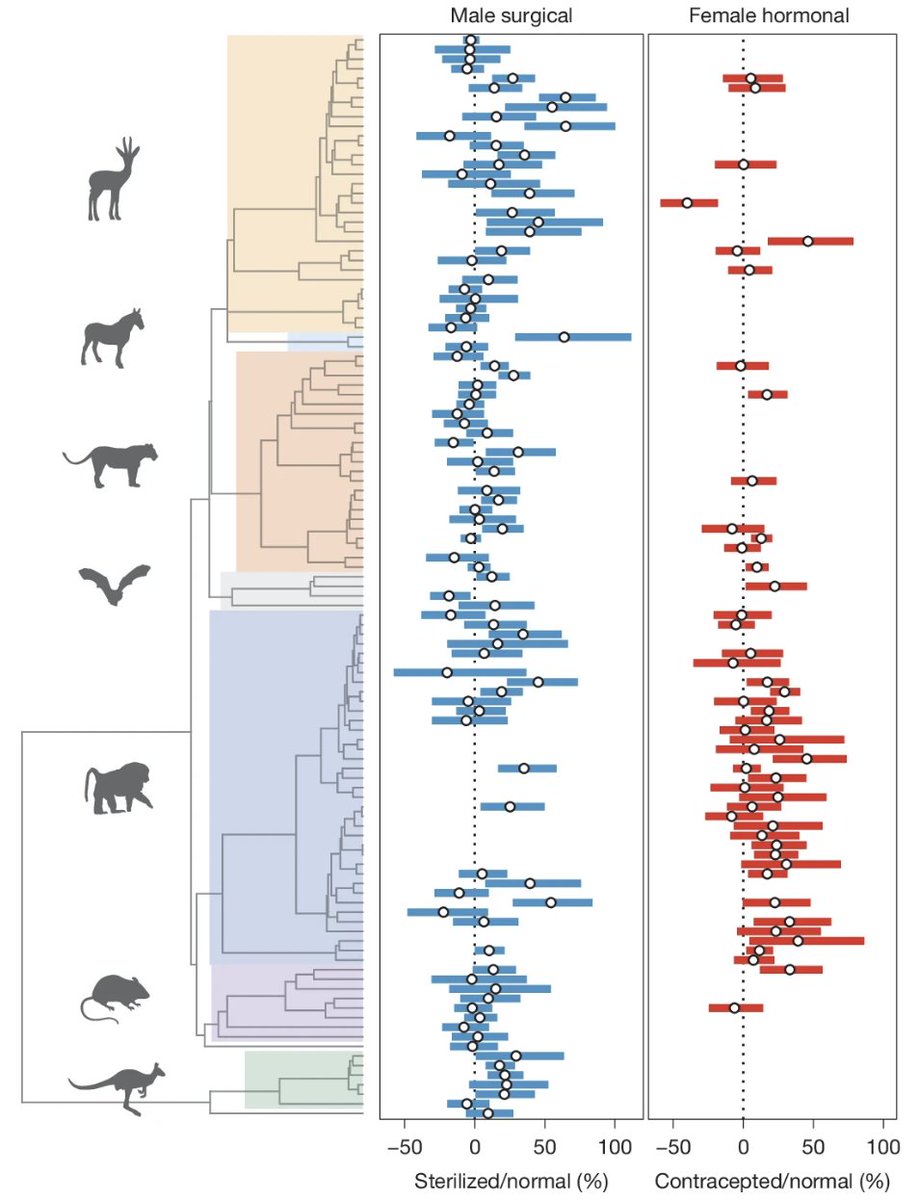
  10. Castration increases lifespan across vertebrates: Or at least, it feels longer.

  1. Pedagogy Recommendations:

    I think the single most thing important I can say is this: Every time you are inclined to use the word “teach”, replace it with “learn”. That is, instead of saying, “I teach”, say “They learn”. It’s very easy to determine what you teach; you can just fill slides with text and claim to have taught. Shift your focus to determining how you know whether they learned what you claim to have taught (or indeed anything at all!). That is much harder, but that is also the real objective of any educator.

  2. How Google Maps quietly allocates survival across London’s restaurants: It's amazing the rabbit holes people will go down.

    I needed a restaurant recommendation, so I did what every normal person would do: I scraped every single restaurant in Greater London and built a machine-learning model.

  3. I didn't think the current LLMs could solve "out-of-sample" problems, ones that are not in their training set. But I was wrong. And another one. These are hard problems from the looks of it.

  1. Automate your life with Claude Code:
  1. Copywriters reveal how AI has decimated their industry: It is coming for the white-collar jobs.

    AI is really dehumanizing, and I am still working through issues of self-worth as a result of this experience. When you go from knowing you are valuable and valued, with all the hope in the world of a full career and the ability to provide other people with jobs... To being relegated to someone who edits AI drafts of copy at a steep discount because “most of the work is already done” ...

  1. A curated list of the best finance blogs, tools, and webpages.

Links: Week of 06 Dec 2025

  1. Humans killed millions of vultures. Now people are paying the price. (WaPo): So many unexpected links and unintended consequences.

    Although other animals scavenge dead cattle, none do so as effectively as vultures. The birds will pick ovedthoughts clean a bull carcass in 30 to 40 minutes.


    A paper published a year ago in the American Economic Review concluded that in certain districts, “the functional extinction of vultures — efficient scavengers who removed carcasses from the environment — increased human mortality by over 4% because of a large negative shock to sanitation.”

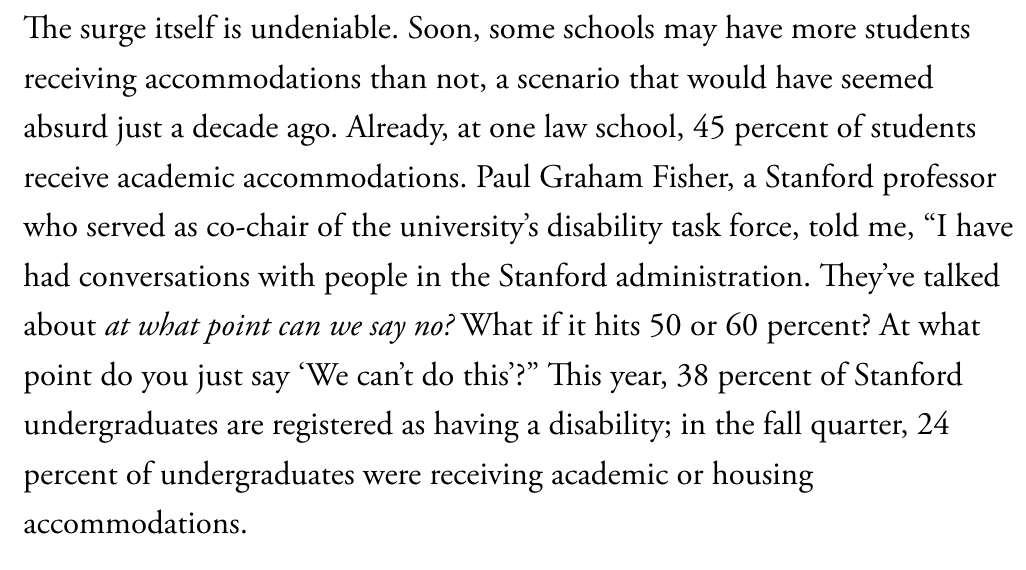
  2. Accommodation Nation:

    At Brown and Harvard, more than 20 percent of undergraduates are registered as disabled. At Amherst, that figure is 34 percent.

    The types of accommodations vary widely. Some are uncontroversial, such as universities outfitting buildings with ramps and providing course materials in braille. These allow disabled students to access the same opportunities as their classmates. Some students get approved for housing accommodations, including single rooms and emotional-support animals.

    Other accommodations risk putting the needs of one student over the experience of their peers. One administrator told me that a student at a public college in California had permission to bring their mother to class. This became a problem, because the mom turned out to be an enthusiastic class participant.

    Professors told me that the most common—and most contentious—accommodation is the granting of extra time on exams. For students with learning disabilities, the extra time may be necessary to complete the test. But unlike a wheelchair ramp, this kind of accommodation can be exploited. Research confirms what intuition suggests: Extra time can confer an advantage to students who don’t have a disability.

  1. 52 things I learned in 2025:

    Global suicide rates have declined by 29% since 2000, due to measures like pesticide bans, more responsible media reporting of suicide, mental health education in schools and improved healthcare responses.

  2. Kidney Recipient Dies After Transplant From Organ Donor Who Had Rabies (NYT): When its your time...

    Since 1978, four organ donors have passed rabies to 13 organ recipients, the report said. Of the 13 recipients, six who received treatment for rabies survived. The seven others, who did not receive treatment, died.

  3. Bublé for a Day, but He Can’t Sing and There’s Little Resemblance (NYT):

    “Any outcome is funny,” Perlman, 36, said in an interview. “If they hate me, it’s funny. If they’re confused, it’s funny. If they love me, it’s funny. And my ego is not wrapped up in the idea of being the best Michael Bublé impersonator, so there’s some freedom in that.”

    After the performance, Perlman was astonished as people approached him for autographs and photos. He riffed about his Christmas special, his children and his love of Canada, and assured a handful of skeptics that, yes, he was the real Bublé.

  4. How Kit Kat Was Killed: Video Shows What a Robot Taxi Couldn’t See (NYT): Both the points below are correct but do they belong in the same paragraph? Of course, Ms. Brigman is right that Kit Kat might still be alive if there was a human driver behind the wheel of that car, but how many more cats and humans will die and be injured because the emotional response to incidents like these delays the adoption of self-driving cars? The response to this accident will make every Waymo better. The same is not true of accidents with human drivers.

    Those who defend Waymo taxis have pointed out that human drivers kill hundreds of animals each year in San Francisco. But Ms. Brigman believes that Kit Kat might still be alive if a human had been behind the wheel that October night.

Links: Week of 29 Nov 2025

  1. How to Fix a Typewriter and Your Life: What a story.

    One Sunday morning in 2014, he opened The Seattle Times and found a feature story about Bob Montgomery, age 92, known to friends, customers and locals simply as Mr. Montgomery. The article read like an obituary for a vanishing trade — fixing typewriters — suggesting that when Mr. Montgomery went, seven decades of expertise would vanish into the digital ether.

    Lundy read it once, then a second time. He had never given old typewriters much thought, but something stirred in him that he could not quite name. He showed the story to his wife, Lisa.

    “I think this might be it,” he told her. The next weekend, he drove to Bremerton, a weary naval town an hour’s ferry ride away and a world apart from gleaming, digitized Seattle.

  2. The Untold Story of Charlie Munger’s Final Years: What a life.

    Near the end of life, Munger leaned on humor for strength. He told family members that Diet Coke was responsible for his longevity, lightening the mood.

    ​And he shared a wish with a visitor.

    “Oh, to be 86 again,” he said.

  3. Cryptographers Held an Election. They Can’t Decrypt the Results.:

    A global group of researchers was unable to read the vote tally, after an official lost one of three secret code keys needed to unlock a hyper-secure election system.

  4. AI in Education?:

  1. Try a ‘fart walk’ to ease the pressure after that big Thanksgiving meal: Nominate for the Ignobel Prize.

    Walking to relieve bloating and gas had long been advocated by doctors, but for years, we had no real experimental proof that it works. So in the mid-2000s, researchers from Barcelona decided to end the speculation and test whether even mild exercise could propel gas forward … and outward.

    The group first looked at healthy volunteers who pedaled on an adapted bicycle going at the equivalent of around 7 mph. The scientists infused gas into the people’s small intestines — mimicking what happens with meals — and then measured how much gas was expelled both during exercise and at rest.

    At rest, the result was a net gain in gas. Not fun.

    But after exercise? Things got juicy. After short bursts of mild physical activity, the scientists found that the amount of gas evacuated was greater than the amount infused. Exercise forced the removal of the added experimental gas and then some — meaning, it also pushed out gas hanging around even at baseline.

    So after a fart walk, you’ll be better off than you started.

Links: Week of 01 Nov 2025

  1. 5'11"?:
  1. Pumpkin Stylists Are Making a Killing This Fall:

    Her most popular package today is her smallest, which costs $325, comes with about 20 pumpkins and takes her six minutes to assemble into a display. The second-most popular is the biggest, at $1,350; that one takes her about 30 minutes. She can do the installations in the dark, wearing a headlamp.

  2. Japan’s sushi legend Jiro Ono turns 100 and is not ready for retirement:

    What’s the secret of his health? “To work,” Ono replied to the question by Tokyo Gov. Yuriko Koike, who congratulated him.

    “I can no longer come to the restaurant every day ... but even at 100, I try to work if possible. I believe the best medicine is to work.”

  3. She hiked the entire Appalachian Trail at 80, unaware she’d just made history:

    The day Betty Kellenberger hit a patch of freezing rain on Mount Madison, quitting crossed her mind. She was hungry, cold and sore.

    “You’re 80 years old,” she told herself in a pep talk atop a mountain in New Hampshire. “You can do it.”

    A few months later, Kellenberger stood at the Massachusetts-Vermont border, having just finished hiking the entire 2,197-mile Appalachian Trail. She became, without realizing it, the oldest woman ever to do it.

    “We put all kinds of limitations on ourselves,” said Kellenberger, who lives in Carson City, Michigan. “Sometimes the biggest one is we don’t get up and try it.”

  4. I Tried the First Humanoid Home Robot. It Got Weird. I look forward to the day something like this becomes real and it may be "real soon now", but I think this take from Daring Fireball is exactly right:

    The argument from CEO Bernt Børnich is that they’re using the videos from the current state of Neo, where its actions are entirely remote-controlled by employees of 1X Technologies, to train its autonomy. I call bullshit. This looks to me like nothing but a scam. It’s not autonomous at all, I don’t believe this company is going to achieve any practical degree of autonomy with this product, and even while it’s remote-controlled by human operators, it’s slow and clumsy.

  1. 5 Tips When Consulting ‘Dr.’ ChatGPT: As someone who has saved hundreds, if not thousands, of dollars in Physiotherapy bill using ChatGPT and is seemingly at the verge of fixing a long-standing chronic back pain, I am a fan. Used sensibly this is a powerful tool. Sensibly being the key word.

    For me, the ability to ask unlimited questions and provide unlimited context was a huge unlock relative to visiting a Physio. Also the time saved going to and from the clinic meant I could be much more regular.

    I fully agree that sharing detailed context and inviting clarifying questions are very important.

    In general, A.I. chatbots are far better at offering answers than asking questions, so they tend to skip the important follow-ups a physician would ask, Dr. Turken said — like whether you have any underlying conditions or are taking any medications. This is especially problematic when you’re asking about potential diagnoses or medical advice.

    To compensate, Dr. Turken recommended prompting the chatbot with a line like: “Ask me any additional questions you need to reason safely.”

  2. When Will Quantum Computing Work?

    Huge investments are flowing into QC companies today. IonQ has a $19B market cap, Rigetti has a $10B cap, and PsiQuantum recently raised $1B.3D-Wave is not relevant, despite high qubit counts. Their machines are annealers, rather than gate based, and have less computational power than the QCs that IonQ, Rigetti, PsiQuantum, etc. are working on. This is a lot of money for an industry generating no real revenue, and without an apparent path to revenue over the next 5 years. Qubit counts have not been doubling each year, but even if they did, we'd have 32 kq machines in 2030.4If qubits double each year, 1,000 qubits today grows to 32 kq in 5 years' time. There are few - if any - commercial applications for machines of that size. Will these companies keep raising larger rounds until they achieve 100 kq? Or have they got some secret sauce we don't know about that investors are betting on?

  3. Depreciation: A skeptical take.

    He assumes that the ASICs are obsolete when they can no longer keep up with the hash rate so are no longer mining any Bitcoin. That is wrong. ASICs are obsolete when the Bitcoin they mine no longer pay for the electricity they use. The newer ASICs aren't just faster, they also use much less energy per hash. Look again at the depreciation graph, which suggests current ASICs go obsolete after 16 quarters. But Alex de Vries and Christian Stoll's estimate of 5 quarters to obsolescence is based on comparing the ASIC's production with the cost of their power consumption, which is the correct approach. The curves in the graph are correct out to the 40% line, but then should drop to zero.

  4. What Palantir Sees:

    Douthat: So we’re going to talk about a lot of things. We’re going to talk about your biography and background, how you came to be an officer in the U.S. military, the future of technology and warfare. But we have to start with a very, very simple question: What is it that Palantir does?

    Sankar: Great question.

    Douthat: Thank you.

    Sankar: Obviously the most important question, yeah.

    Douthat: I spent a long time crafting it, I have to say.

Links: Week of 18 Oct 2025

  1. Happy Diwali to those who celebrate! NYT had two glossy stories on just one Diwali Ball in New York organized by Priyanka Chopra's manager. Made me go "Hmmm...". Was this about Diwali, was this about Priyanka Chopra or was this something else?

  2. London Became a Global Hub for Phone Theft. Now We Know Why. Not a fan of clickbait headlines in NYT TBH but this story was revealing. I was under the impression that phone theft was a thing of past because of the hard to crack passcodes. Turns out not. The article didn't make it very clear how the thieves could get the phones working again. Apparently they can be sold for parts and something something China. Anyway, time to be careful out there again.

  3. The pendulum has swung away from wokeness and cancel culture, as it should have. But sometimes it feels like, instead of passing through the center it went straight to the other end.

  4. Title Arbitrage as Status Engineering:

    Title arbitrage is one of the most scalable levers a company can pull to increase the status of certain roles and attract talent. It costs nothing, works at scale, yet has the ability to reshape labor markets. The design space for title arbitrage remains wide open.

  5. There are many ways through which the LLM subscriptions pay for themselves. For me it was physiotherapy. Here it is filing tax returns. I also wish more people would share "how tos" for solving different problems with LLMs. Here's a manual for tax returns. Full disclosure: I haven't tried it yet but the source is credible.

  1. Five technological achievements! (That we won’t see any time soon.):

  2. Observations on AI and the Capital Markets in 2025

    "To provide some sense of scale, that means the equivalent of about $1,800 per person in America will be invested this year on AI". That is a bucketload of spending.

  3. China Can't Win: Retweets are not endorsments, as they say. However there is a chorus of experts out there loudly claiming that China holds the upper hand in the tariff negotiations with US. I am not so sure and this looks like a worthwhile counterpoint. Added to reading list.

    China cannot win the decoupling because they face an impossible trilemma: protect the currency, bail out the banks, or maintain social stability. They can pick two at most. More likely, they get one. The math is unforgiving: $5-10 trillion in hidden property losses against $3 trillion in bank equity. That’s not a solvency problem—it’s a physics problem. Meanwhile, they’re bleeding $1.1 trillion annually just to hide the losses, burning their entire defense and R&D budget combined on financial zombies.

  4. Now that wokeness is over, is it ok to link to Louis CK clips again? Can one separate the art from the artist? I don't know but I love this one:

Links: Week of 11 Oct 2025

  1. An Economists Guide to Weight Loss: Pre-Ozempic. New Year Resolution?

  2. The Patel Motel Story: I hope its well done. Must watch.

  3. 99 Percentile vs. 99.9 Percentile: Some of the responses are insightful too. This can be the problem of growing up in a small town or going to a "weaker" school for a certain type of person.

  1. Bernie Madoff Stole My Savings. Here’s How I Got My Life Back.: Hats off.

    I think people who are facing a sudden reversal can learn from my experience. You can get through it. You have family, you have friends, you have resources that you don’t even know that you have.

  2. Average? I had to go down about 100 responses before someone asked, "Man or woman?"

Links: Week of 20 Sep 2025

  1. If you’ve got a compliment, just let it out.
  1. And the amazing thing is that the opposite works too!

    I think I mentioned this before but I was a national speech and debate octafinalist in high school and I was able to parlay that into a job running a debate program at an ambitious charter middle school in college.

    My approach was the exact opposite of this. Like half the kids were TERRIFIED of public speaking and were only doing it because their tiger moms insisted they had to (and the other half LOVED the attention).

    I had a lot of trouble getting the scared kids to open up and one day I asked one of the youngest ones what made her so afraid of speaking in front of the class, especially since they were all her friends.

    And she told me she was afraid she’d say something dumb or make a mistake and everyone would make fun of her. And that they’d laugh and laugh at her if she froze up.

    The next day I asked the class if anyone was scared of being made fun of and all the shy kids raised their hands.

    Now I don’t actually know if this is the same pathology in adults with fear of public speaking but I suspect it’s similar, and now I’ll get to how I addressed it which worked fabulously.

    First I told them that this was a ridiculous fear and that no one would make fun of them. But of course that doesn’t do anything lol. But then I told everyone to rip out 10 pieces of paper from their notebooks and crumple them up.

    And I told them I was going to give a speech. I told them if I said “uhh” or “um” or used any filler words they were to throw a paper ball at me and shout “shame!” 3 times pointing at me.

    And I gave a terrible speech. And they loved it! It was so much fun for them.

    But then! I had the students give speeches with the same rules, starting with the confident ones.

    After the third student the shy ones were volunteering.

    After the lesson I explained to them that we had accomplished 2 things:

    1. We had demonstrated how absurd such a reaction really is, because none of them would have ever reacted in that way if they weren’t specifically asked to, and none of them had any actual malice even when they did shout “shame” at their classmates

    2. Everyone had experienced the comically worst case scenario imaginable of public speaking and survived!

    So they became the rule during EVERY class and I was told by the other teachers that my shy students had started leading presentations and speaking up in class and some of them asked me how I worked with them.

    They were HORRIFIED when I told them lol.

    But it worked!

    This reminds me of Boggarts in the Harry Potter books.

  2. Church Planting: When Venture Capital Finds Jesus:

    This guy is founding an evangelical church, and I find his ecosystem fascinating. First for its stunning similarities to venture-capital-funded tech start-ups, and then for its simplicity and open-heartedness. None of the dynamics in church planting are unique or even particularly rare, but they are unobfuscated, and that makes church planting the equivalent of a large print book for the social dynamics that favor charismatic narcissists.

  3. Moon helium deal is biggest purchase of natural resources from space:

    Finnish tech firm Bluefors, a maker of ultracold refrigerator systems critical for quantum computing, has purchased tens of thousands of liters of Helium-3 from the moon — spending “above $300 million” — through a commercial space company called Interlune. The agreement, which has not been previously reported, marks the largest purchase of a natural resource from space.

  4. We Are Going to Have to Live Here With One Another (NYT): I try to avoid posting political or negative items but this was worth making an excception for. A long and insightful discussion between Ezra Klein and Ben Shapiro. Eye opening, if you read with an open mind.

  5. They traveled to Thailand. They wound up cyber scam slaves in Myanmar.: Scary. I am not sure I like graphical news but an interesting experiment.

  6. Teen depression has declined for the past 4 years, after peaking in 2021.:

  1. ICPC medals for OpenAI and Gemini:

    We received the problems in the exact same PDF form, and the reasoning system selected which answers to submit with no bespoke test-time harness whatsoever. For 11 of the 12 problems, the system’s first answer was correct. For the hardest problem, it succeeded on the 9th submission. Notably, the best human team achieved 11/12.

    We competed with an ensemble of general-purpose reasoning models; we did not train any model specifically for the ICPC. We had both GPT-5 and an experimental reasoning model generating solutions, and the experimental reasoning model selecting which solutions to submit. GPT-5 answered 11 correctly, and the last (and most difficult problem) was solved by the experimental reasoning model.

    and

    An advanced version of Gemini 2.5 Deep Think competed live in a remote online environment following ICPC rules, under the guidance of the competition organizers. It started 10 minutes after the human contestants and correctly solved 10 out of 12 problems, achieving gold-medal level performance under the same five-hour time constraint. See our solutions here.

Links: Week of 6 & 14 Sep 2025

  1. Jeremy Lin Retires After 15 Years That Included ‘Linsanity’ With the Knicks (NYT):

    The journeyman played for eight N.B.A. teams and won one championship. But he is best known for a brief stretch on the Knicks where he electrified fans and the nation.

    How to feel old #3892: Linsanity for 13 years ago and I remember it like it was yesterday!

  2. How to resist everyday temptations: A guide we can all use, but probably won't.

  3. You're Overthinking Packing:

    The amount of planning and thought that needs to go into the enterprise is surprisingly minimal. Count how many days you’re going for, then bring the same number of shirts as the number of days minus one (unless you have access to laundry, then probably less), 2-4 pairs of pants, a couple nicer dresses if that’s your thing and a change of shoes. Something to sleep in at night and a bathing suit if you’re headed somewhere warm. I always bring an extra pair of underwear and socks because sometimes I like to change throughout the day. Then experiment by trying on a bunch items to ensure everything goes together. Frankly, it’s not that different than figuring out what you’re going to wear on a day-to-day basis, which I trust you do all the time.

    Some thinking about packing, maybe some tools (I like using packing cubes and a travel scale is a must when flying budget) are surprisingly useful but yes, the curve drops sharply.

  4. My journey from ADHD skeptic to Adderall enthusiast:

    At 22, I thought ADHD was fake. An excuse for underachieving kids to get “accommodations” for procrastinating on their homework. From what vague knowledge I had of stimulants like Adderall, I regarded them with the same scorn as the accommodations.

    Seventeen years later, I credit Adderall with enabling me to build a 10x happier, healthier, more virtuous version of myself (to the chagrin of the countless Twitter trolls decrying my “meth addiction” in reply to this recent viral post). Here is my story.

  5. What Is Man, That Thou Art Mindful Of Him?: God and Iblis debate if human intelligence is hitting a wall. Hilarious and insightful.

  6. if you meet the singaporean on the road:

    All this effort — fifty years of non-stop toil — turning a fallow wasteland into fertile earth, and where are all the crops we have to show for it? Where are all the local companies that we can point to and be proud of? Where are our Ericssons and Nokias?

  7. LLMs Will be Like Ozempic for Golf:

    Rob was fantastic but it’s not as though I can just do a TrackMan excursion all the time. Yet I remained curious about why my swing was what it was. I had decent power, but lacked the ability to square the ball up with anything approaching consistency. Was I destined to always have this problem?

    And so I turned to LLMs, feeding the TrackMan stats into GPT. Based on 12 numbers, from one swing, GPT had me clocked. It knew my strengths and weaknesses. It fully understood the specifics of my poor technique. I’m sure Rob could have walked me through as much, but his time is limited. The machine had all the bandwidth in the world to deal with my “over the top” swing, how to fix it, and any other questions I might nag it with.

    A day later, my swing was different and self recorded video sent to Google’s Gemini confirmed the change. Swing errors that were decades in the making were corrected in the span of minutes. I’m not saying that I’ve suddenly made a leap from “Struggles to break 100” to “scratch golfer.” I’m just saying that a process that could have been expensive and arduous was instead efficient and relatively cheap. I apply the LLM’s fix, and it tells me whether I’ve actually applied it. The feedback is instant and objective.

    LLMs will be like Ozempic for a lot more than golf. Ability to ask unlimited questions without feeling embarrased or paying by the hour is a big deal. Imagination is the only thing limiting us.

  8. GPT-5: The Case of the Missing Agent

    It’s hard to say exactly why, even with all this progress, current AI models are still so hopeless at dealing with open-ended real-world situations. GPT-5’s inability to recognize that it was incapable of playing Minesweeper may indicate that its reasoning abilities do not generalize well. Its decision to spend 5 solid hours beating its head against the unimportant side goal of sharing a spreadsheet suggests a lack of training on the importance of setting priorities. The repeated factual errors in Gemini 2.5 Pro’s writeup of its merch store experience (click the link and look for “Editor’s Notes”) suggest an inability to keep track of key information over an extended project. Claude losing track of the fact that it is not a person is a reminder that in some ways these models really are just shallow imitations of human behavior (even as they demonstrate deep capability in other areas).

    So many benefits and so many limitations.

  9. Reading with AI:

    Reading a non-fiction book from cover-to-cover is not efficient. I used to say that I read books “from the outside in.” I look at the book flap to find out about the author, who wrote the blurbs, and the subject matter of the book. Then I read the introduction and conclusion in order to get the main ideas. If I have read something by a different author that seems relevant, I look for that author in the index, and I head to those pages.

    and

    Once again, I believe in “Stop, Look, and Listen.” I start by asking the AI to summarize the key themes of the book. For each theme that the AI lists, I stop and try to put it into my own words. I test my understanding by feeding my words into the AI, in order get confirmation that my interpretation is correct. Another way that I ensure understanding is to suggest possible examples or ask the AI to provide examples.

  10. How to think about AI progress: Reproducing the entire post as it really is worth reading:

    The Zvi has a good survey post on what is going on with the actual evidence. I have a more general point to make, which I am drawing from my background in Austrian capital theory.

    There are easy projects, and there are hard projects. You might also say short-term vs. long-term investments.

    The easier, shorter-term projects get done first. For instance, the best LLMs now have near-perfect answers for a wide range of queries. Those answers will not be getting much better, though they may be integrated into different services in higher productivity ways.

    Those improvements will yield an ongoing stream of benefits, but you will not see much incremental progress in the underlying models themselves. Ten years from now, the word “strawberry” still will have three r’s, and the LLMs still will tell us that. There are other questions, such as “what is the meaning of life?” where the AI answers also will not get much better. I do not mean that statement as AI pessimism, rather the answers can only get so good because the question is not ideally specified in the first place.

    Then there are the very difficult concrete problems, such as in the biosciences or with math olympiad problems, and so on. Progress in these areas seems quite steady and I would call it impressive. But it will take quite a few years before that progress is turned into improvements in daily life. Again, that does not have to be AI pessimism. Just look at how we run our clinical trials, or how long the FDA approval process takes for new drugs, or how many people are reluctant to accept beneficial vaccines. I predict that AI will not speed up those processes nearly as much as it ideally might.

    So the AI world before us is rather rapidly being bifurcated into two sectors:

    a) progress already is extreme, and is hard to improve upon, and

    b) progress is ongoing, but will take a long time to be visible to actual users and consumers

    And so people will complain that AI progress is failing us, but mostly they will be wrong. They will be the victim of cognitive error and biases. The reality is that progress is continuing apace, but it swallows up and renders ordinary some of its more visible successes. What is left behind for future progress can be pretty slow.

    Yet another periodic reminder that MR and The Zvi are both must-read for everyone.

Links: Week of 23 Aug 2025

  1. Why Is Martha’s Vineyard Going Vegan? It’s All About Tick Bites. (NYT):

    On the porch of the Chilmark General Store and at sunset-watching parties on Menemsha Beach, conversations circle ineluctably to the lone star tick, which after a single bite can leave people with a life-threatening allergy to most meat and dairy.

    Known as alpha-gal syndrome, the condition is changing the way many people shop, cook and eat in a place long known as a food-lover’s retreat for its thriving independent farms and restaurants. These new habits may prove to be lasting, as some islanders who initially avoided beef and cheese temporarily, out of necessity, later give them up for good out of preference.

    “It’s sort of supersized vegetarianism,” said Rebecca Miller, a farm owner who has the syndrome herself.

  2. Are Samosas Unhealthy? Some Indians Find Official Advice Hard to Swallow.:

    So, when a recent government advisory put samosas — along with other deep-fried Indian snacks and Western foods such as burgers and French fries — on a list of things that should be eaten in moderation because of their high oil and sugar content, there was an unsurprising outcry. Social media erupted with memes, and Indian media chimed in to say the country’s most iconic bites were under attack.

  3. @rivatez:

    That animals seemingly anticipate events should humble us more. Changes in groundwater chemistry, electromagnetic fields and sound waves make animals restless, distressed and even relocate

    In the West it is seen as ‘woo’ to contemplate that energy/weather humans don’t consciously experience can affect our psychology, and yet we forget that we are animals too.

    Even outside extreme weather events, the lunar cycle moves oceans, huge bodies of water. We are, like all animals, primarily made of water. The word ‘lunacy’ comes from the ancient understanding that our minds can be affected by it

    An interesting experiment is to log your daily mood for a few months- ups and downs, anxiety / joy levels, big arguments with loved ones etc. Then afterwards, retroactively chart it against lunar cycles and NASA space weather data that tracks geomagnetic storms, solar flares etc.

    Be open- minded and try it. I, too, used to think this stuff was BS

    Now I think much of modern psychiatry is giving people drugs to tune down people’s individual responses to these external inputs, eg ‘bipolar’ might just indicate high sensitivity

    How many important scientific breakthroughs lie on the other side of our collective dismissal of ‘woo’?

    cows
  4. Why I believe in AGI (again):

    First, I’m now convinced that ChatGPT understands what it reads. Second, reasoning models persuade me that ChatGPT is creative. Third, ChatGPT summarizes texts extremely well, which I believe to be a robust measure of intelligence.

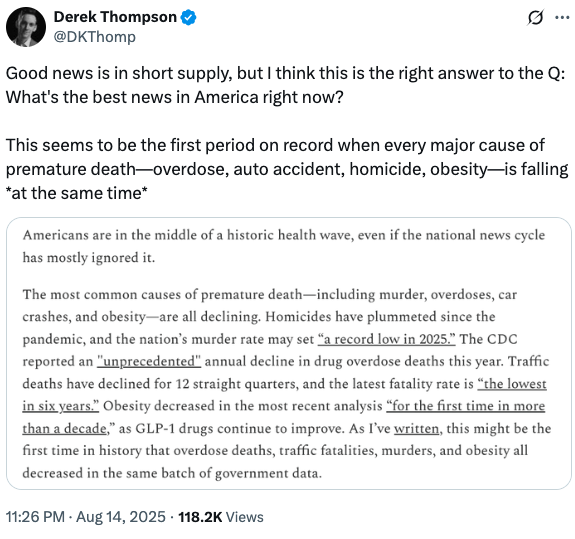
  5. Derek Thompson: Good News

    "The better news is that this is happening at a time when exercise seems to be increasing for many groups, especially the young and old. The bad news is ... deep Medicaid cuts and declines in childhood vaccine uptake are not exactly optimistic predictors of American health."

  6. Your Review: Dating Men In The Bay Area: Not what it says on the label at all! Recommended.

  7. Adults Are Going to Sleep-away Camp to Make Friends. It Seems to Actually Work.:

    “Anyone that has worked at camp or grown up in the camp world understands there is a powerful people connection that forms at camp,” said Liam Macleod, a longtime camp professional and marketing director at Camp No Counselors. “It’s camp magic and it’s hard to replicate in the regular world.”

  8. What is the most profitable thing you have done with ChatGPT? on Reddit via Simon Willison: In dollar terms, probably crafting fundraising messages for charity event organized by my Alumni Association. In real terms, physiotherapy for my back and legs. So far. Some great examples at the link. Failure of imagination remains the biggest hurdle in getting value from LLMs.

  9. AI Is Designing Bizarre New Physics Experiments That Actually Work:

    It took months of effort to understand what the AI was doing. It turned out that the machine had used a counterintuitive trick to achieve its goals. It added an additional three-kilometer-long ring between the main interferometer and the detector to circulate the light before it exited the interferometer’s arms. Adhikari’s team realized that the AI was probably using some esoteric theoretical principles that Russian physicists had identified decades ago to reduce quantum mechanical noise. No one had ever pursued those ideas experimentally. “It takes a lot to think this far outside of the accepted solution,” Adhikari said. “We really needed the AI.”

  10. GPT-5 prompting guide:

    GPT-5, our newest flagship model, represents a substantial leap forward in agentic task performance, coding, raw intelligence, and steerability.

    While we trust it will perform excellently “out of the box” across a wide range of domains, in this guide we’ll cover prompting tips to maximize the quality of model outputs, derived from our experience training and applying the model to real-world tasks. We discuss concepts like improving agentic task performance, ensuring instruction adherence, making use of newly API features, and optimizing coding for frontend and software engineering tasks - with key insights into AI code editor Cursor’s prompt tuning work with GPT-5.

    We’ve seen significant gains from applying these best practices and adopting our canonical tools whenever possible, and we hope that this guide, along with the prompt optimizer tool we’ve built, will serve as a launchpad for your use of GPT-5. But, as always, remember that prompting is not a one-size-fits-all exercise - we encourage you to run experiments and iterate on the foundation offered here to find the best solution for your problem.

    And a tutorial by Anthropic.

  11. Class Dismissed: Alpha School is getting a lot of coverage all of a sudden. Long piece about the people and the tech behind it.

Links: Week of 19 Jul 2025

  1. The Diaspora Paradox Second in a series from Samir Varma

    But here's the paradox that has haunted me for decades: Why do so many Indians who escape India's constraints become more Indian abroad? Why does the uncle who couldn't be bothered to visit temples in Mumbai suddenly become a founding member of the Hindu temple in New Jersey? Why does the software engineer who rebelled against arranged marriage in Bangalore now insist their American-born daughter marry within the community?

  2. The First in 30 Years: Scientists Discover New Class of Antibiotics:

    Led by scientist Gerry Wright, the team has discovered a powerful new molecule called lariocidin. This promising candidate shows the ability to fight some of the toughest, most drug-resistant bacteria known to science. Their groundbreaking findings were published in the journal Nature.

  3. Why We’re Surrounding Our Kids with AI:

    We also don’t plan on perpetuating modern Western parents’ egregiously hands-off nature with regard to their kids’ dating and marriage prospects. We already have a going list of agentic, thoughtful, high-achieving families whose kids are close to our kids in age; as our kids get older, we’ll start organizing gatherings for families in this network where our kids can hang out and get to know each other (trips, summer camps, discord servers, study groups, etc.). As our kids reach their late teens and early 20s, we’ll begin organizing modern versions of the London Season—a series of events and gatherings at which our single kids ready for marriage can meet, mix, and get to know each other.

    Did not see this coming.

  4. Babies made using three people's DNA are born free of hereditary disease:

    Eight babies have been born in the UK using genetic material from three people to prevent devastating and often fatal conditions, doctors say.

    The method, pioneered by UK scientists, combines the egg and sperm from a mum and dad with a second egg from a donor woman.

  5. The Sputnik vs. Deep Seek Moment: The Answers

    I pointed out that the US response to Sputnik was fierce competition. Following Sputnik, we increased funding for education, especially math, science and foreign languages, organizations like ARPA were spun up, federal funding for R&D was increased, immigration rules were loosened, foreign talent was attracted and tariff barriers continued to fall. In contrast, the response to what I called the “DeepSeek” moment has been nearly the opposite. Why did Sputnik spark investment while DeepSeek sparks retrenchment? I examine four explanations from the comments and argue that the rise of zero-sum thinking best fits the data.

  6. Reflections on OpenAI:

    I left OpenAI three weeks ago. I had joined the company back in May 2024.

    I wanted to share my reflections because there's a lot of smoke and noise around what OpenAI is doing, but not a lot of first-hand accounts of what the culture of working there actually feels like.

  7. ChatGPT Agent and Gold-medal level performance in International Math Olympiad (IMO). More on the IMO.

  8. Psychological techniques to persuade AI.

  9. Spud-tacular: How India became a french fry superpower:

    Gujarat has become India's capital of french fry production, home to huge factories churning out chips, including facilities belonging to Canadian giant McCain Foods and India's biggest maker of French Fries, HyFun Foods.

  10. Bill Ackman changed Tennis forever.

Links: Week of 05 Jul 2025

  1. John Oliver on AI Slop:
John Oliver is always funny and often insightful.
  1. Defeating a Virus That Killed Half a Billion People - The Plea. Timely and important. Trigger warning: Images of diseased people.

  2. Operation Midnight Hammer: What a story.

  3. Helicopter Money. Literally. Talk about going out in style.

  4. Does CPS Investigate One Third of All Children in the US? Yes. But...

    The scale of CPS investigations in the US is staggering. Like all things, this trend began in the late 60s and early 70s as mandatory reporter laws expanded and caused massive growth in child maltreatment reports. Since the 90s, the number of reports has stayed pretty stable and the number of substantiated investigations and interventions has been falling.

    The CPS could probably scale back it’s interventions for cases of maltreatment that only involve neglect, especially those that only involve lack of supervision rather than physical neglect. Other tradeoffs between false positive and false negative investigations and interventions are more difficult to have a strong opinion on given the terrible outcomes on both sides of the trolley track.

    There are probably some available pareto improving moves. The most straightforward in my view would be increasing staffing and state capacity in family courts so that cases can be reviewed more accurately and without requiring months or years of effort and tens of thousands of dollars on the part of the parents.

  5. Tech C.E.O. Pays $400,000 to Conduct the Toronto Symphony (NYT):

    After the performance, Cheung and the orchestra received a standing ovation. He said he was grateful for the opportunity.

  6. Will AI Drive 20%+ Annual GDP Growth?:

    Steam, electricity, computers delivered enormous benefits while their economic importance shrank through success. AI will transform society profoundly. But 20% GDP growth? History says no.

  7. Medical Superintelligence from Microsoft?:

    Microsoft's LLM is not only designed for multiple-choice questions, but also for real medical diagnoses in realistic scenarios – and outperforms even top models such as o3.

    In a large-scale study with over 300 case studies from the New England Journal of Medicine, the system achieved a diagnostic accuracy of over 80%. This is not only four times higher than the participating doctors, but also marks a qualitative leap: the AI was not only more accurate, but also made more economical decisions – with around 20% lower costs because it avoided unnecessary tests.

  8. A Doctor Responds

    Microsoft claims their new AI framework diagnoses 4x better than doctors.

    I'm a medical doctor and I actually read the paper. Here's my perspective on why this is both impressive AND misleading ...

    ...

    Final thought: We don't need AI that can diagnose every rare disease. We need AI that knows when to diagnose and when to reassure. That's the real art of medicine.

  9. Gymnastics Bot using LEGO SPIKE Prime. My weekend project.

Links: Week of 01 & 08 Jun 2025

  1. More kids are beating cancer. Improving the rest of their lives is next. (WaPo)

    When oncologists gave my 5-year-old daughter the all-clear from high-risk neuroblastoma in 2010, I breathed a sigh of relief.

    But her health needs were just beginning.

    Fifteen years later, the intense and often toxic treatments that saved Emily’s life have left her with a host of lifelong health challenges — hearing loss, stunted height, endocrine and kidney dysfunction, and permanent hair-thinning — issues no one talked about during her 18 months of cancer treatment.

    A good problem to have from one perspective but no less hard to deal with.

  2. Questions about AI 2025:

    My working hypothesis is that human cognition improves markedly once pen is put to paper, and in some cases can continue to improve with extended writing (but note many prominent failures).

    This is correct and yet I do this less than I should. Time to commit to writing non-link posts weekly?

  3. Exact Instructions Challenge (YouTube): Fun.

  4. A ‘Mission: Impossible’ Fan Favorite Returns 3 Decades Later. Even He’s Surprised. (NYT)

    But according to the “Final Reckoning” director Christopher McQuarrie, Donloe made a big impact. In fact, he said in an interview, fans frequently asked him when he was going to bring the character back. For a long time, he didn’t understand why Donloe engendered such love, until he heard the question framed in a different way: “When is the team going to do right by what they did to Donloe?”

    “And I realized why William Donloe resonated,” McQuarrie said. “There was a perceived injustice, whether anybody could put their finger on it or not.”

  5. The Rise of the Japanese Toilet (NYT):

    In 1982, a peculiar commercial aired on televisions across Japan.

    An actress in a pink floral dress and an updo drops paint on her hand and futilely attempts to wipe it off with toilet paper. She looks into the camera and asks: “Everyone, if your hands get dirty, you wash them, right?”

    “It’s the same for your bottom,” she continues. “Bottoms deserve to be washed, too.”

    Civilization on the march.

  6. Zarna Garg Went From Stay-at-Home Mom to Stand-Up Comedian (NYT):

    After 16 years focusing on her husband, Shalabh, and her three children — Zoya, Brij and Veer — Ms. Garg re-entered the work force in 2019, but not to return to her erstwhile career as a personal injury lawyer. Instead, encouraged by her children, she started working the New York open-mic circuit and performing at Westside Comedy Club before headlining at Caroline’s on Broadway by 2020.

    In 2023, she talked her way into opening for Tina Fey and Amy Poehler on their Restless Leg Tour, and Prime Video aired her special “One in a Billion.” This spring, she made her film debut in the critically acclaimed rom-com “A Nice Indian Boy.” Her second special, “Practical People Win,” will air on Hulu in July, and she is developing a sitcom called “Zarna” with Mindy Kaling and Kevin Hart.

  7. The Lightcone Podcast on Prompting (Video Podcast): I am hungry for more such reources.

  8. Chattel Childhood: Trigger warning - fairly explicit start and parts.

    I don’t approve of the Simbari childrearing, not because I think the pain and disgust of what the children are forced to do is inherently bad, but because they are forced.

    To love someone skillfully is to pour fuel on their soul. It’s to see the world through their desire, to delight in it, and go “I desire you to get what you want.” It is the amplification of their will.

    The Simbari people are destroying the will of their children. My parents destroyed my will. And I think, quite seriously, that our current culture is likewise destroying the will of its children en masse. That’s what you do to property.

    Worth thinking about although largely I don't agree with this. Her will seems to be doing just fine.

    I think humans are are social animals and whether something traumatizes us or not is often (but not always) a function of the social context surrounding the event. What happens to the Simbari children (if it in fact, does happen. I have not verified or heard of this before) doesn't traumatize them because everyone around them considers it perfectly normal.

    In my mental model, the trauma happens, when you feel something shameful or otherwise different has happened to you and everyone looks at you different.

  9. Artichokes: For the photos.

  10. High cost of building in US:

    Zuckerburg's worth is 226 billion. The NY Subway builds tunnels at $4 bil. per mile. SF's BART builds subways at $2 bil. per mile. It's crazy that all of Zuckerberg's wealth would build just 8% of the current NYC subway network.

    Meanwhile in Paris cost $250 mil. per mile.

  11. UFO?:

    The object was precognitive in behavior. The radar data from the SPY-1B system showed that the Tic Tac descended from 28,000 feet to sea level in 0.78 seconds, a feat requiring acceleration up to 5,880 Gs. But here's what no one focuses on: that data was correlated by both radar and infrared, meaning this was not a sensor glitch or hallucination...it was a multi-spectrum-confirmed, real-world event. And what’s worse? The object decelerated to a dead stop… mid-air. Bonkers!

Links: Week of 25 May 2025

A long list today because this week two of my top sources were on fire - MR and NYT.

  1. My Parents Expected to Be Retired. Instead, They Are Raising My Sister’s Kids. (NYT): Beautiful, heartbreaking and uplifting.

  2. Still booting after all these years: The people stuck using ancient Windows computers: None of the above. Well... maybe heartbreaking. No need to click the link though, the title says it all.

  3. Measles cases in Europe, the Americas skyrocket: This is infuriating for two reasons. The second reason is that you wouldn't know it from reading most news that Europe has 10x the cases of USA. NYT I can understand, but I had to scroll down 3 pages on BBC website, after searching for "measles" to find a story about something other than RFK Jr. and Texas moms.

  4. Your Fingers Wrinkle in the Same Pattern Every Time After Long Exposure to Water: Heh. Also apparently they wrinkle to improve underwater grip, not because the skin expands by absorbing water, which would have been hypothesis.

  5. How Miami Schools Are Leading 100,000 Students Into the A.I. Future (NYT)

  6. 5 weeks ago, someone buried a 22 lb chest with $10,000 of prizes (half in gold), somewhere in San Francisco. No one has found it yet. This is the only clue. It was found within a day of this post, so clearly the only thing holding back the search was the number of eyes looking. How many other problems is this true for?

  7. "One of main goals in life has been to make my parents proud". 92% in Iraq, 78% in India. I remember realizing sometime in my early 30s that my parents didn't know the hierarchy of success in my field. As far as they were concerned I was already successful after college and any "actual" success wouldn't register with them. I felt the void in my movtivation for quite some time. Having your own kids helps with the transition.

  8. AI & Critical Thinking:

    An interviewer just asked me what skills AI will make more important. My response? Critical thinking skills.

    This is because in the past there was value in creating large quantities of information. That is now costless. The new currency is how to generate, assimilate, interpret, and make that large amount of information actionable.

    The next question then becomes how do we teach, and improve our own, critical thinking skills? I discuss that in a recent study where I create a critical thinking skills hierarchy.

  9. The Agentic Web and Original Sin: I have been wondering about this problem for a while - who puts up the content for the LLMs to train on if everyone gets their answers from the chatbots and doesn't visit websites anymore.

    The problem, as both I and Patel noted, is that this ecosystem depends on humans seeing those webpages, not impersonal agents impervious to advertising, which destroys the economics of ad-supported content sites, which, in the long run, dries up the supply of new content for AI.

    A potential solution:

    First, the protocol layer should have a mechanism for payments via digital currency, i.e. stablecoins. Second, AI providers like ChatGPT should build an auction mechanism that pays out content sources based on the frequency with which they are cited in AI answers. The result would be a new universe of creators who will be incentivized to produce high quality content that is more likely to be useful to AI, competing in a marketplace a la the open web; indeed, this would be the new open web, but one that operates at even greater scale than the current web given the fact that human attention is a scarce resource, while the number of potential agents is infinite.

  10. Cargo Ship Crashed Into Man’s Yard After Crewman Fell Asleep, Police Say (NYT)

  11. The 22 Best Pizza Places in New York Right Now (NYT)

  12. New Studies Dismiss Signs of Life on Distant Planet (NYT): Dang.

  13. SEO for AI: A look at Generative Engine Optimization

  14. The best bookstore in NYC, and then some

  15. They’re 15. Wait Until You Read Their Newspaper. (NYT):

    “We still haven’t done hot dogs,” Teddy said. Billy agreed: Hot dogs should be an editorial priority.

    and

“We were still very young; we had no idea what we were doing,” said Billy, a junior varsity quarterback whose hair was tousled into a cruciferous mop.

  1. Know hope!

    …Use of digital technologies was associated with reduced risk of cognitive impairment (OR = 0.42, 95% CI 0.35–0.52) and reduced time-dependent rates of cognitive decline (HR = 0.74, 95% CI 0.66–0.84). Effects remained significant when accounting for demographic, socioeconomic, health and cognitive reserve proxies.

    Paper here.

  2. Putting Claude 4 Opus in an open playground to chat with itself led to it diving into philosophical explorations of consciousness, self-awareness, and by 30 turns it eventually started using Sanskrit: Can't wait till nationalist politicians from my home state get their hands on this. Sanskrit!

  3. Toronto burger shop called Good Fortune Burger renamed its menu items to sound like office supplies, helping remote workers potentially expense meals through work accounts. The "basic steel stapler" and "braided HDMI cord” are popular. : As a reply points out this doesn't make sense because the order is still from a place called Good Fortune Burger.

  4. Who Benefits from Surge Pricing?:

    What are the welfare effects of surge pricing? Using Uber data, I develop an empirical model of spatial equilibrium composed of demand, supply, and matching. I find that surge pricing raises total welfare, benefitting riders but hurting drivers.

    Welfare effects differ substantially across sides of the market: rider surplus increases by 3.57% of gross revenue, whereas driver surplus and the platform’s current profits decrease by 0.98% and 0.50% of gross revenue, respectively.

    This doesn't make sense. If it hurts the platform or the drivers, why would they do it?

    After dropping the pearl of wisdom above, I decided to actually read the paper. In the first two pages I found this:

Uber’s current profits decrease by 0.50% of gross revenue. This probably does not mean that Uber is hurt, but rather that it is willing to forgo current profits to increase rider surplus—the right choice if it believes that long-run shareholder value is more closely tied to rider surplus and customer retention than to current profits.

Makes sense. After this my eyes glazed over and I dropped the paper in Claude and asked it why drivers would participate in this. Here's what it says: 

The paper acknowledges this is the more problematic finding. "My findings suggest that drivers might have good reason to complain. Their hourly earnings are not much higher than the minimum wage, so even the small effects I find might be a concern."

However, drivers may not have full information about the counterfactual (uniform pricing), and many drivers are part-time workers using Uber for supplemental income rather than as their primary employment.

Links: Week of 04 May 2025

  1. How to make hard choices (YouTube): A great video and especially personally relevant right now.

  2. Just how good is O3 at playing GeoGuessr: Apparently very good. It still makes errors of course, but I was amazed at how close it got with very limited clues. Worth repeating this bit from last weeks link:

    It’s also deeply dystopian. Technology can identify locations from photographs now. It’s vitally important that people understand how easy this is—if you have any reason at all to be concerned about your safety, you need to know that any photo you share—even a photo as bland as my example above—could be used to identify your location.

  3. Universal Antivenom May Grow Out of Man Who Let Snakes Bite Him 200 Times (NYT):

    The video is just under two and a half minutes long. A slim man with close-cropped hair walks into a room, pulls a long black mamba — whose venom can kill within an hour — from a crate and allows it to bite his left arm. Immediately after, he lets a taipan from Papua New Guinea bite his right arm. “Thanks for watching,” he calmly tells the camera, his left arm bleeding, and then exits.

    Over nearly 18 years, the man, Tim Friede, 57, injected himself with more than 650 carefully calibrated, escalating doses of venom to build his immunity to 16 deadly snake species. He also allowed the snakes — mostly one at a time, but sometimes two, as in the video — to sink their sharp fangs into him about 200 times.

  4. Ken Rogoff on Conversations with Tyler: Great discussion on so many different topics - China, Pakistan, US, Chess. I found it very insightful.

  5. Macro Utopia: Economics heavy list today but I have found Scott Sumner to have the most useful and probably most accurate predictions about macro.

Links: Week of Mar 15 2025

  1. Australian man survives 100 days with artificial heart in world-first success via Nico McCarty:

    An Australian man with heart failure has become the first person in the world to walk out of a hospital with a total artificial heart implant.

    The Australian researchers and doctors behind the operation announced on Wednesday that the implant had been an “unmitigated clinical success” after the man lived with the device for more than 100 days before receiving a donor heart transplant in early March.

    The BiVACOR total artificial heart, invented by Queensland-born Dr Daniel Timms, is the world’s first implantable rotary blood pump that can act as a complete replacement for a human heart, using magnetic levitation technology to replicate the natural blood flow of a healthy heart.

  2. Inflation Expectations by Political Party Affiliation: Entry #3692 in "Politics makes you stupid".

  3. Broccoli, the Man – and Vegetable – Behind the Bond Franchise: What a story.

  4. The shift from a mindset of scarcity to one of abundance is overdue.(NYT Paywall) The article itself has a strong partisan tone. I hope the book is different.

    In the time California has spent failing to complete its 500-mile high-speed rail system, China has built more than 23,000 miles of high-speed rail. China does not spend years debating with judges over whether it needs to move a storage facility. That power leads to abuse and imperiousness. It also leads to trains.

    I do not want America to become China. But I do want it to be able to build trains.

  5. Some Vegans Were Harmed in the Watching of This Movie (NYT Paywall): Even as a vegetarian, this seems over the top.

    “People might think a glass of milk is innocuous,” she said. “It’s not. It’s full of violence.”

  6. In Search of a Boring Business (NYT Paywall):

    On BizBuySell, the popular listings site where the Rizzos found the Smiths, “corporate refugees” ditching the 9-to-5 have surged to 42 percent of buyers, roughly double the 2021 figure. Meanwhile, nearly a quarter of American small businesses are owned by people 65 and older, making the Smiths part of a “silver tsunami” of sellers.

  7. Cognitive security is now as important as basic literacy: Must read link of the week. Between this stuff and use of AI in scams, I am more than a little scared.

  8. Is this good or bad? Policy can be hard.

Links: Week of Mar 08 2025

  1. James Harrison: The Man Who Saved 2.4 Million Babies: Hall of Fame.
  2. Coincidentally, this week both Tyler Cowen and Karthik S shared memories of playing card games as kids. And then today my sister mentioned my younger newphew had started playing Dungeons and Dragons recently. We have played card games and board games with our boys, especially during COVID and it was fun. Clearly we should do more of this.
  3. Another entry to the hall of fame. A different hall, sure, but come one, clearly this guy is a legend.
  4. A different way of learning math? Via Zvi, who belongs in a third hall. Can't fault him for lacking ambition but perhaps this is the rare tweet that should have been an article.
  5. A Cheeto Shaped Like the Pokemon Charizard Sells for Nearly $90,000. NYT Paywall but do you really need to read anything else?
  6. Honey on a razor blade: Something about the actual visualization struck a chord with me.

Links: Week of 19 Jan 2025

  1. This feels accurate. 😅. He says AGI but looking at the next link I wonder if this is true for plain old AI.
  1. Two weeks ago, it was Will Smith eating pizza. Now its this. Click the link to see the video. WhatsApp University is about to go nuts.
  1. She Is in Love With ChatGPT (NSFW. NYT Paywall.) And you thought K-Dramas were stealing your spouse.

  2. The Serendipity Machine or how to use Twitter better. A few years ago I implemented a simple algorithm on my twitter feed:

    a. Block everyone who talks about politics and

    b. Block everyone who is is dissing / attacking anyone / anything.

    In less than a month my feed stopped being the anxiety inducing, doomscrolling nightmare that it was and transformed into the best source of learning & inspiration on internet. This piece takes you to the next level.

    Committing to writing this newsletter has also been great. Now instead of mindlessly flicking my finger and consuming, I have a purpose every time I open Twitter. Its almost energising to engage actively with each tweet, thoughtfully considering whether its fit to be served to my exceptionally smart and good-looking audience.

  3. E(X)>0: An Open Letter to Elon:

    “Your top engineers and programmers are only able to work 80-hour weeks because they can hire nannies and maids, ride in Ubers, and order food delivery. High-skill productivity depends on an abundance of complementary low-skill productivity.”

    As a repeat immigrant, I have many thoughts on this debate going on in US right now. There’s a lot that is wrong with a policy of focusing exclusively on so called Skill or Merit based immigration. This piece from Bryan Caplan makes some good points.

  4. The War for India: I am enjoying this talk by Prof. Sarah Paine of the Naval War College. She talks about the history of international conflict and politics in South Asia and the role to US & Russia. I did not know that India supported China’s bid for a permanent seat on the UN Security Council. 🤯 😱

  5. Better ways to wear a Polo: Always a pleasure to see a master in action.

“…networking conferences where there’s plated cantaloupe.” chef’s kiss.

Here’s another one from Derek:

  1. Fix Your Glutes. (NYT Paywall) Strongly endorse. Really helps when trying to hold a fart but many other benefits too.

    My frail-as-porcelain glutes — the cluster of tissue from hip to thigh tasked with keeping the body upright and on occasion propelling it forward — were causing a domino chain of damage, and had most likely been doing so for some time. To compensate for the glutes’ infirmity, my ankles, knees, hips and even my shoulders and arms had to thrash madly, taking on vast and uneven amounts of pressure, often far more than they were structurally fit to bear

    and

    Only after I started remedying my “gluteal amnesia” (real medical term) did it become clear how little I knew about basic affairs like walking, standing and sitting (or living, for that matter). Within a week of the mandated twisting and shimmying and clam-shelling, my spine was noticeably straighter, smoother. Four weeks later and I could finally walk without pain again. It took three months more to fully rebalance my loopy musculature and break into a manageable jog — but when I did, I noticed a wondrous new power to each step and spring. My reawakened haunch muscles were doing their job.

    For the last two months, I have been doing a core workout formulated personally for me by (who else?) ChatGPT, with a special focus on glutes and I can feel the difference, not just in my ability, but my willingness to do things. Core strength is underrated and it isn’t just about the abs. You can have a six-pack and a weak core. I happen to have one of those.

That’s it for this week. It seems like my writing and links are all AI all the time but that isn’t the intention. However it is a space where a lot of fun stuff is happening right now and so that’s the path of least resistant.

I will be on the road for the next few weeks so programming may be light. Hopefully the website will be ready soon.

×